Jun 16, 2026
Remembering David Hockney
A vibrant Hockney scene made a memorable appearance at the AGO in 2022
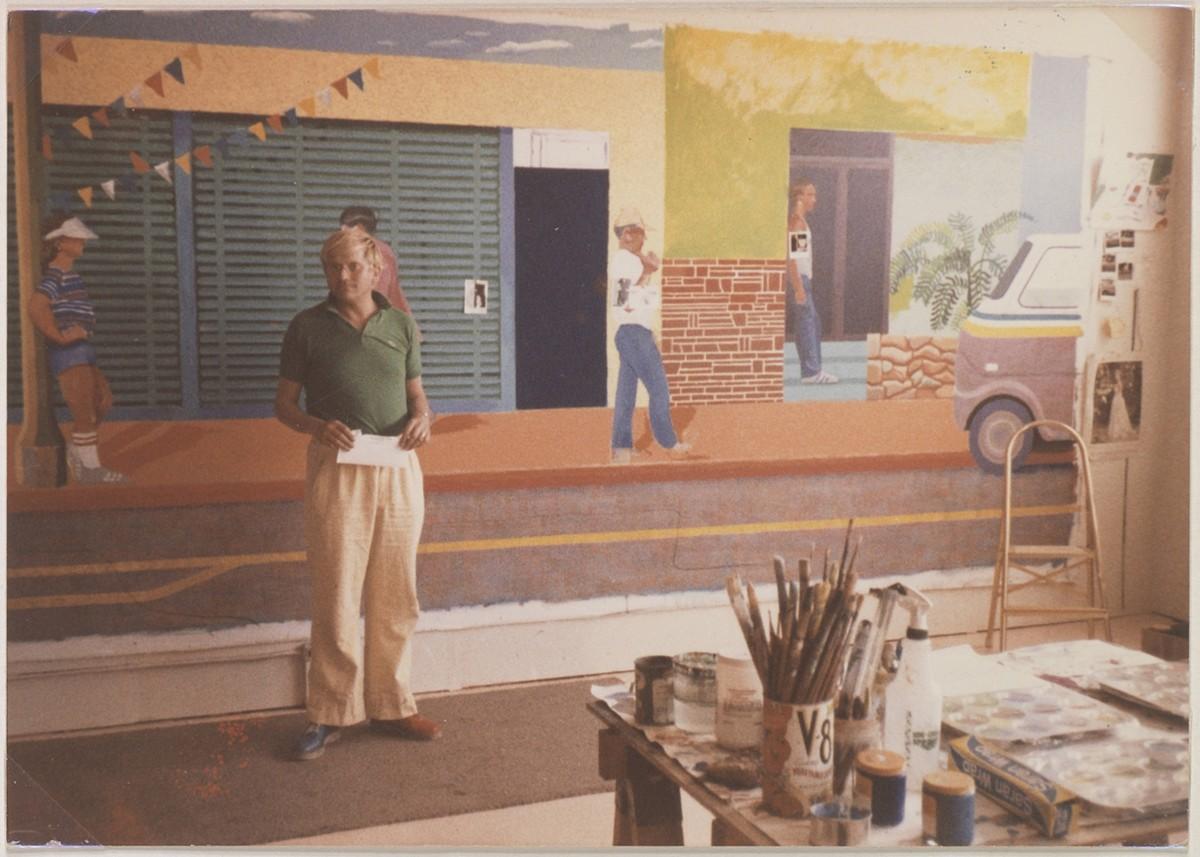
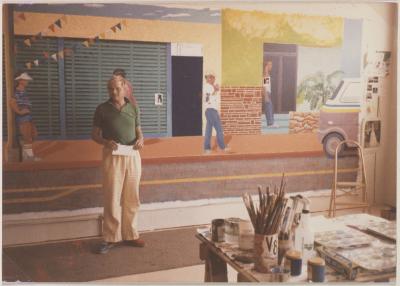
David Hockney working on Santa Monica Boulevard in his studio, West Hollywood, California, circa 1978-80. © David Hockney
“Colour is a joyful thing. I want my art to be joyful.”
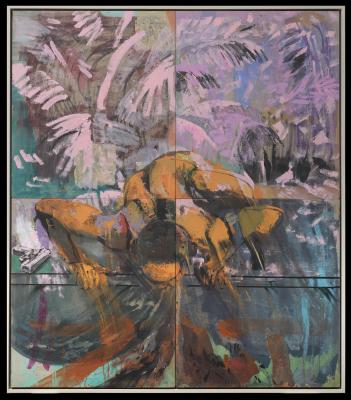
Renowned British artist David Hockney died on June 11, 2026, at the age of 88. In 2022, a rarely seen painting by Hockney was a highlight of the AGO exhibition I AM HERE: Home Movies and Everyday Masterpieces. Completed between 1978 and 1980, Santa Monica Boulevard captures a panoramic view of the famed West Hollywood street, painting it in vibrant pinks, oranges and teals.
Hockney lived in Los Angeles for nearly forty years, beginning in 1964. He painted Santa Monica Boulevard on an unstretched canvas in his West Hollywood studio.
As the art world reflects on Hockney’s legacy, Foyer revisits this 2022 interview about Hockney’s monumental, twenty-foot-wide painting, which made its way to the AGO that year. A team of dedicated conservators in Los Angeles and the AGO worked to mount the work on a stretcher so it could make its North American debut here in Toronto.
L.A. Monumental
In Santa Monica Boulevard (1978–80), Hockney captures a sun-drenched snapshot of the iconic West Hollywood street in Los Angeles, painting it with DayGlo-esque pinks, oranges and teals. At the AGO, the painting appears against a bright blue wall as a backdrop, making the colours pop even more. Some passages are rendered with crisp detail; others with thick impasto-like strokes. Parts of the painting appear slightly unfinished with thin sketched lines peeking through layers of acrylic paint. Placing viewers directly into the scene as if they were driving by in a car, Hockney transforms ‘the everyday’ and enlarges it to a monumental scale. People move about their day across the canvas, unaware of the viewer’s gaze – walking down the street purse in hand, leaning against a wall in a doorway. As Hockney has said about Los Angeles, “If you’re looking for a shop, there will be a big sign above the little building so you can recognize it at speed. The architecture is made to be seen when you’re moving fast.” Like the rest of the works in I AM HERE, Santa Monica Boulevard is an energetic celebration of ‘the everyday’ as it is lived.
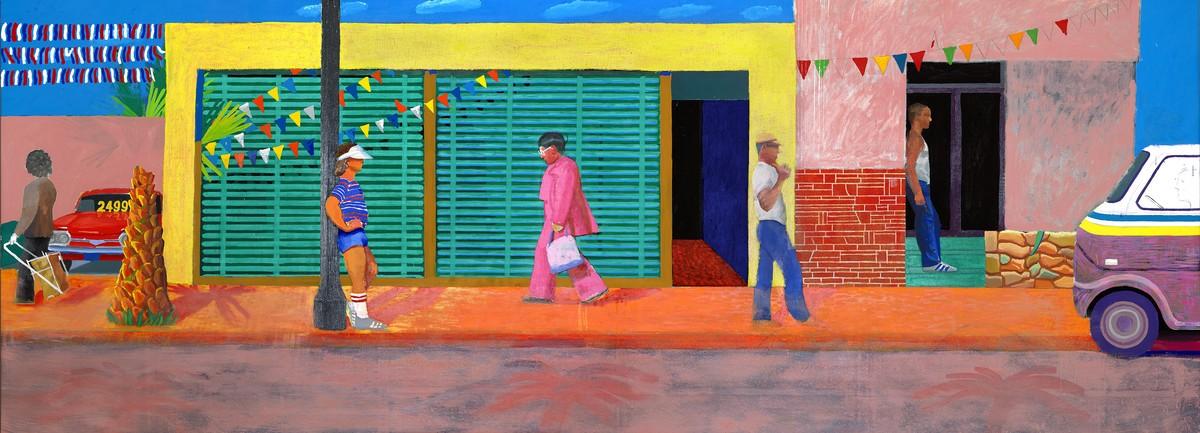
David Hockney, Santa Monica Boulevard, 1978 – 80. Acrylic on canvas, 218.44 x 609.6 cm. Collection The David Hockney Foundation © David Hockney. Photo: David Egan
Hockney lived in Los Angeles for forty years, beginning in 1964. It was on the cusp of the 1980s that he painted Santa Monica Boulevard on an unstretched canvas in his West Hollywood studio. It was later rolled up and stored away by the David Hockney Foundation, unseen publicly for nearly three decades, except once in 1994 in Japan. This showing at the AGO is the first time the painting has been on view in North America and mounted on a stretcher, as originally intended.
But just how and why did the painting make the journey from Los Angeles to Toronto? Jim Shedden, Curator, Special Projects and Director, Publishing at the AGO, explained that “We knew a lot of so-called ‘non-art’ works would be included in I AM HERE, so we wanted to pinpoint the artists who were not strongly represented in our [AGO] Collection [and] who are associated with embracing ‘the everyday’ as their subject matter. Hockney came to mind.” Shedden and exhibition co-curator Alexa Greist, Curator & R. Fraser Elliott Chair, Prints and Drawings, first came across the painting in a book of Hockney’s work, not fully realizing its scale (Santa Monica Boulevard is one of his largest paintings to date). Greist added, “This painting just kept jumping out at us, not only because of the brightness [of it] but also in its themes. We thought about how it embraces the ‘street’, and one's moving through the spaces and the places you visit all the time.” The curators were unaware that the painting hadn’t been on view in years, bringing into question its condition and whether it could be shown at all. Add to that, Hockney himself had to approve whether the painting could be displayed.
Miraculously, the painting was revealed to be in relatively good shape – good enough that putting it on view was a real possibility. Hockney gave his approval as well, captured in the photographs below. Eugena Ordonez, a California-based independent conservator specializing in modern to contemporary paintings, was tasked to carefully assess the condition of the work and, working with a team, preparing it for the exhibition.
When the painting arrived at the AGO, she worked on it again, this time with Christina G.A. McLean-Alsaidi, AGO Assistant Conservator, Paintings. To better understand what was involved in preparing Santa Monica Boulevard (1978–80) for exhibition, Ordonez shared her expert insights.
Note: Santa Monica Boulevard (1978-80) is no longer on view at the AGO.
Foyer: Can you share an overview of the conservation process, from your first assessment to the installation of Santa Monica Boulevard (1978–80) at the AGO?
Eugena Ordonez: Almost every step of the conservation process involved working as part of a group because of the painting's size. The artist was also involved during this project because the painting had never been mounted on a stretcher before, so it was critical that the artist decide on the dimensions of the work.
When the painting was unrolled for examination, it was a great relief to see that it was in overall good condition and mainly needed some general maintenance. The painting was first stretched in Los Angeles, which was a good practice run for the second stretching at the AGO.
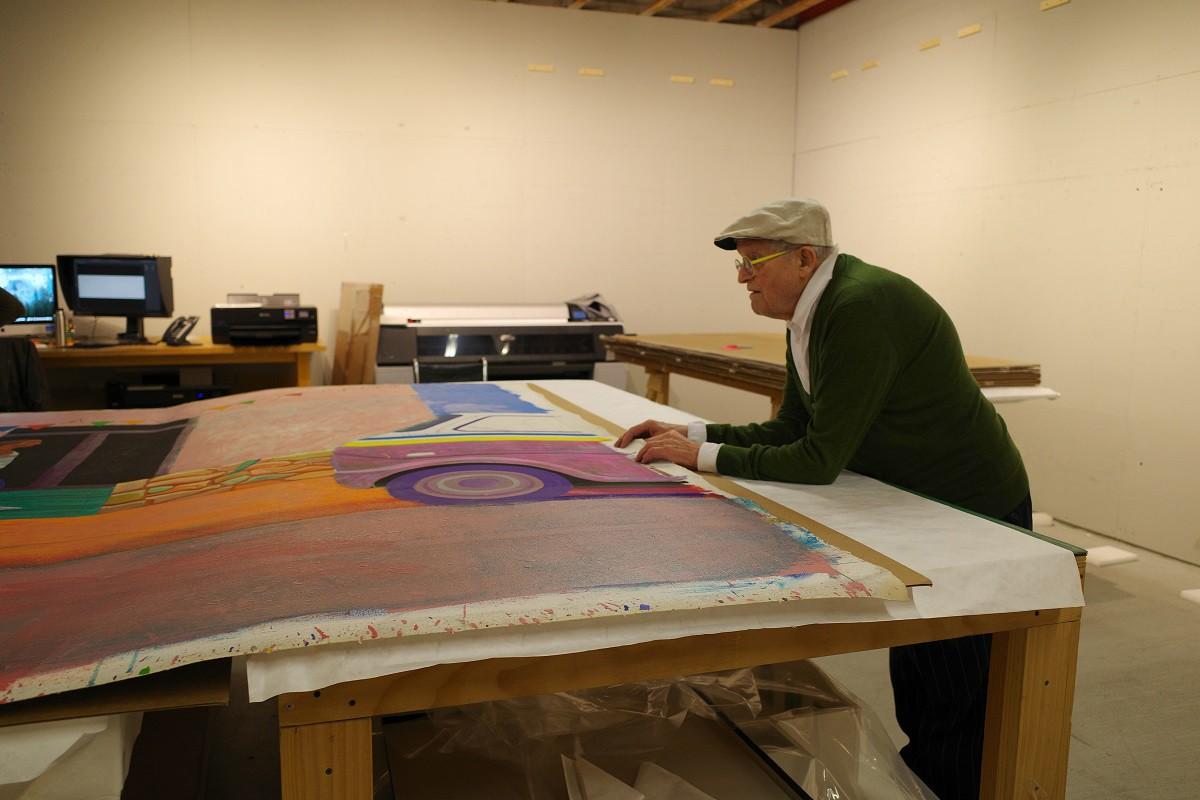
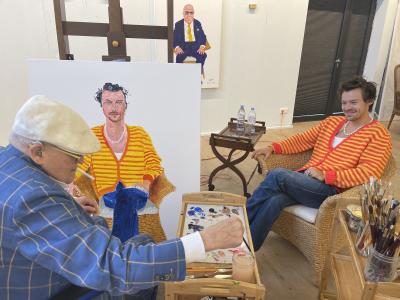
David Hockney inspecting his work Santa Monica Boulevard in his studio, West Hollywood, 2020. © David Hockney. Photo: Jonathan Wilkinson
Can you tell us about the folding wood stretcher that was created and why it was needed?
The size of the painting played a critical role in deciding on a folding stretcher. Whereas the painting was rolled for shipment, the stretcher needed to be made more compact for safer shipment and possibly cost factors as well. The ability of the stretcher to be converted to about half of its width for shipment and then to be expanded and become a sturdy support again, when the painting needed to be stretched, greatly facilitated the whole process of transporting the work and exhibiting it elsewhere.
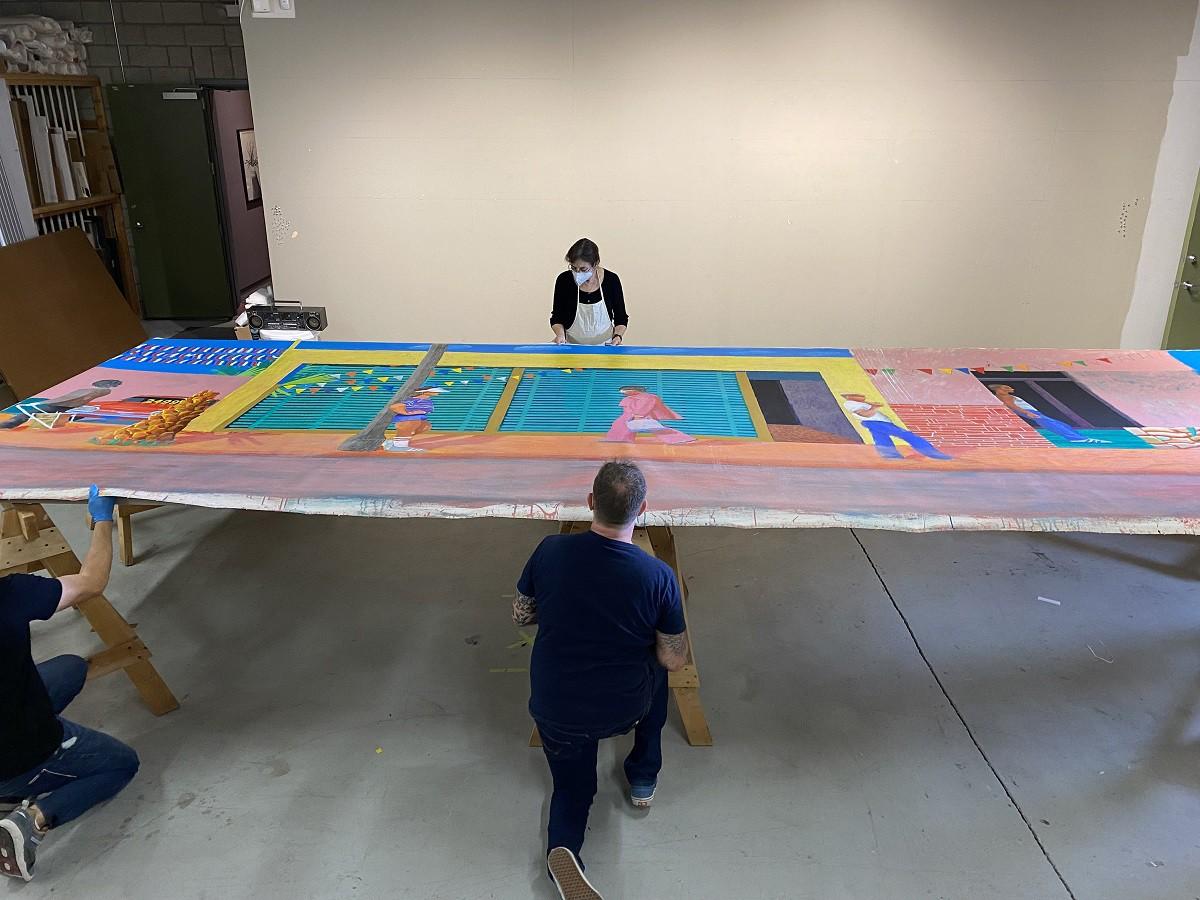
Stretching the canvas, Santa Monica Boulevard in the studio, January 2022, West Hollywood, California. © David Hockney
Did you learn anything about Hockney’s techniques as a painter through this process? Was there anything unanticipated in terms of how the paint was applied that impacted your work or approach?
Being able to see the photographic images he used to create this work, which have been collected in a notebook on the painting, was a unique experience. What he chose to keep in great detail and what was eliminated when he painted the image using these photographs was very interesting. Closer examination of the painting reveals how fearless he was in removing painted objects and reworking passages.
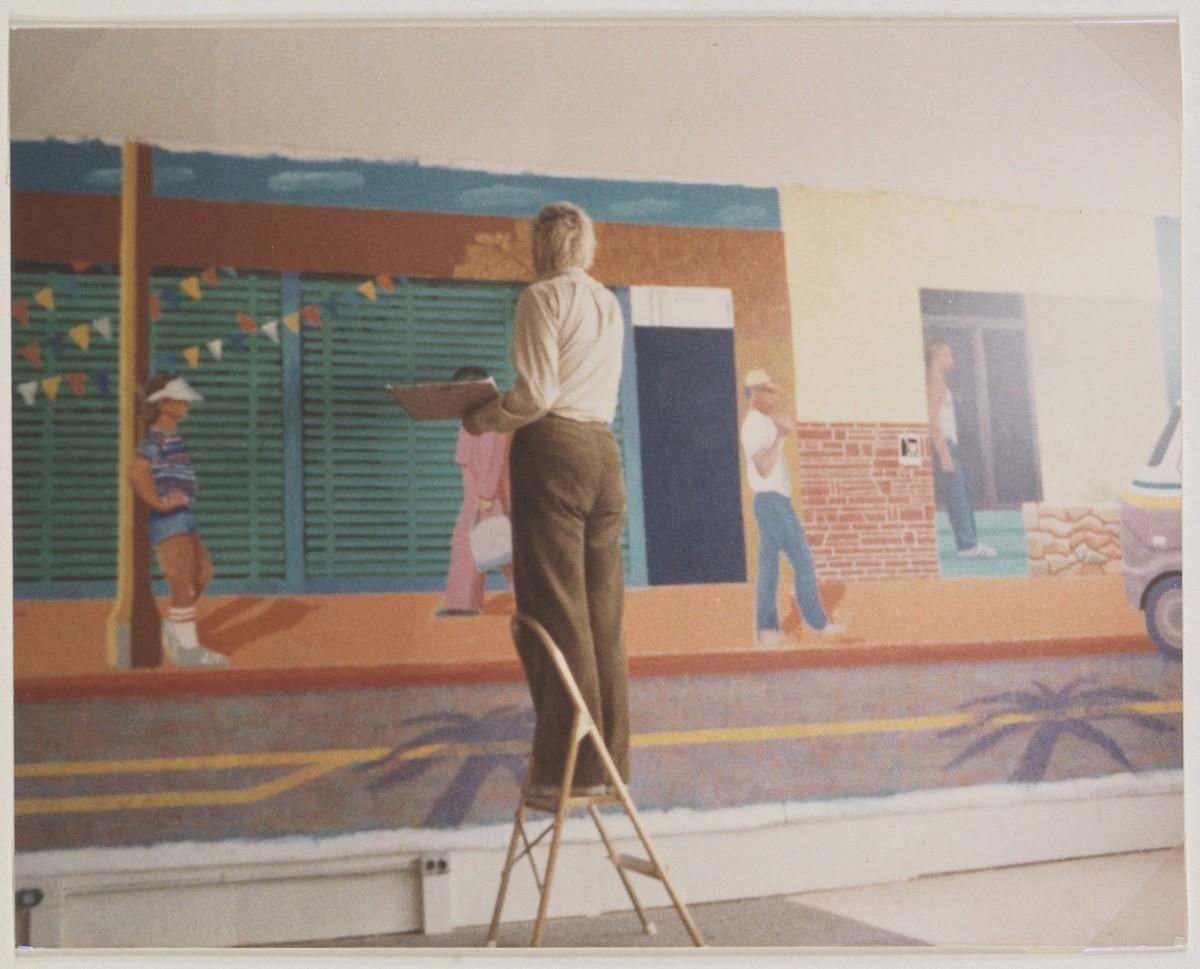
David Hockney working on Santa Monica Boulevard in his studio, West Hollywood, California, circa 1978-80. © David Hockney
Have you worked on any other works by Hockney? If so, how did this conservation process compare?
I have worked on several dozen of his paintings, but none so large and none with these particular issues (creating the fold lines and preparing such a large work for travel). His painting technique is fairly traditional and the quality of the materials used is good, so usually the conservation treatments deal with problems caused by external factors.
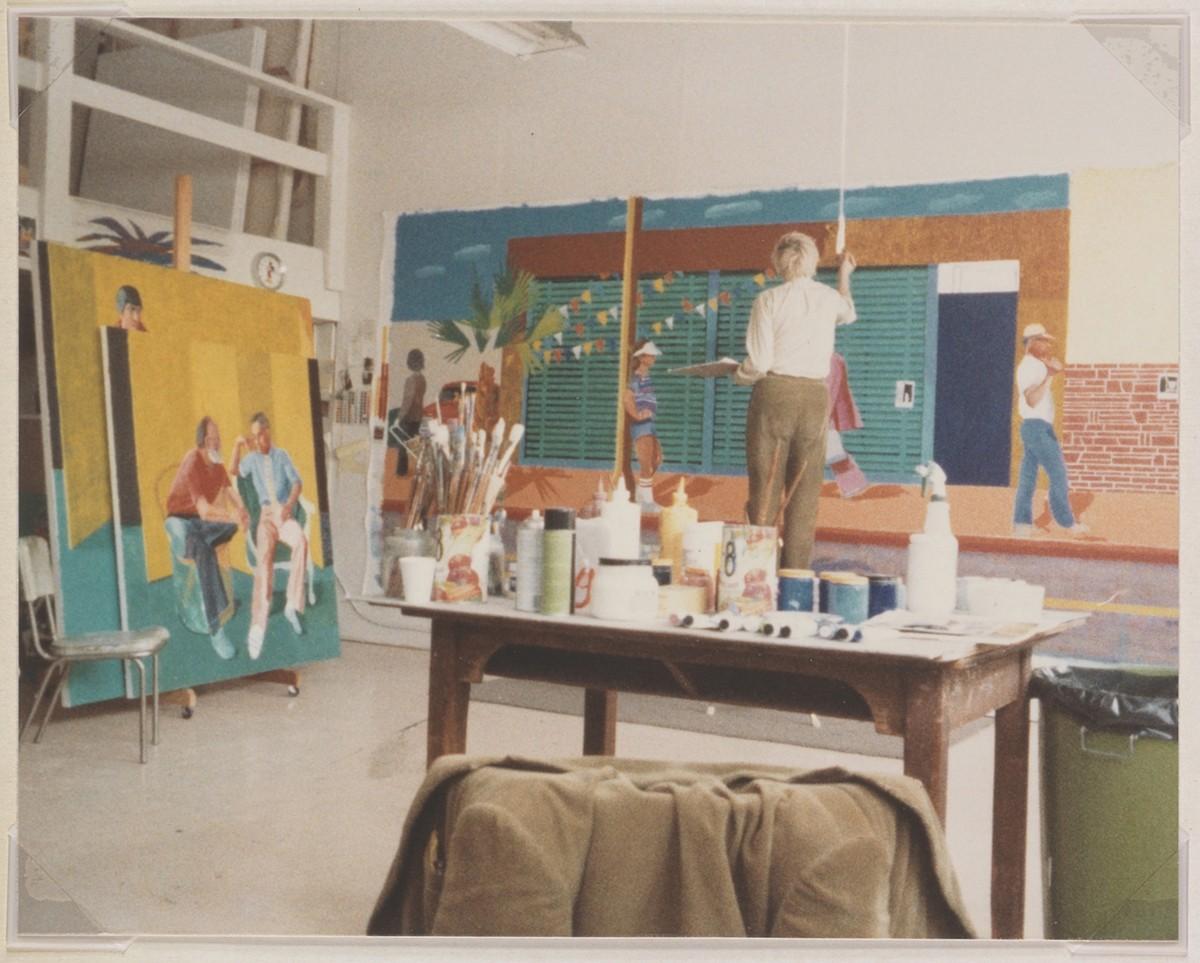
David Hockney working on Santa Monica Boulevard in his studio, West Hollywood, California, circa 1978-80. © David Hockney
You've spent a lengthy amount of time with this painting. What interesting details might someone miss at a cursory glance?
What is easily missed and what made stretching the painting rather challenging is the scarcity of actual straight horizontal and vertical lines in the work. In practice, this meant that when one edge (for example, of a wall or street) was established as straight (parallel to one of the edges of the stretcher), other lines appeared angled in the image. We had to keep shifting the painting's position, prior to securing it on the stretcher, to find just the right balance of "straightness" for the vertical and horizontal edges and resorted to various methods and tools to help us determine that.
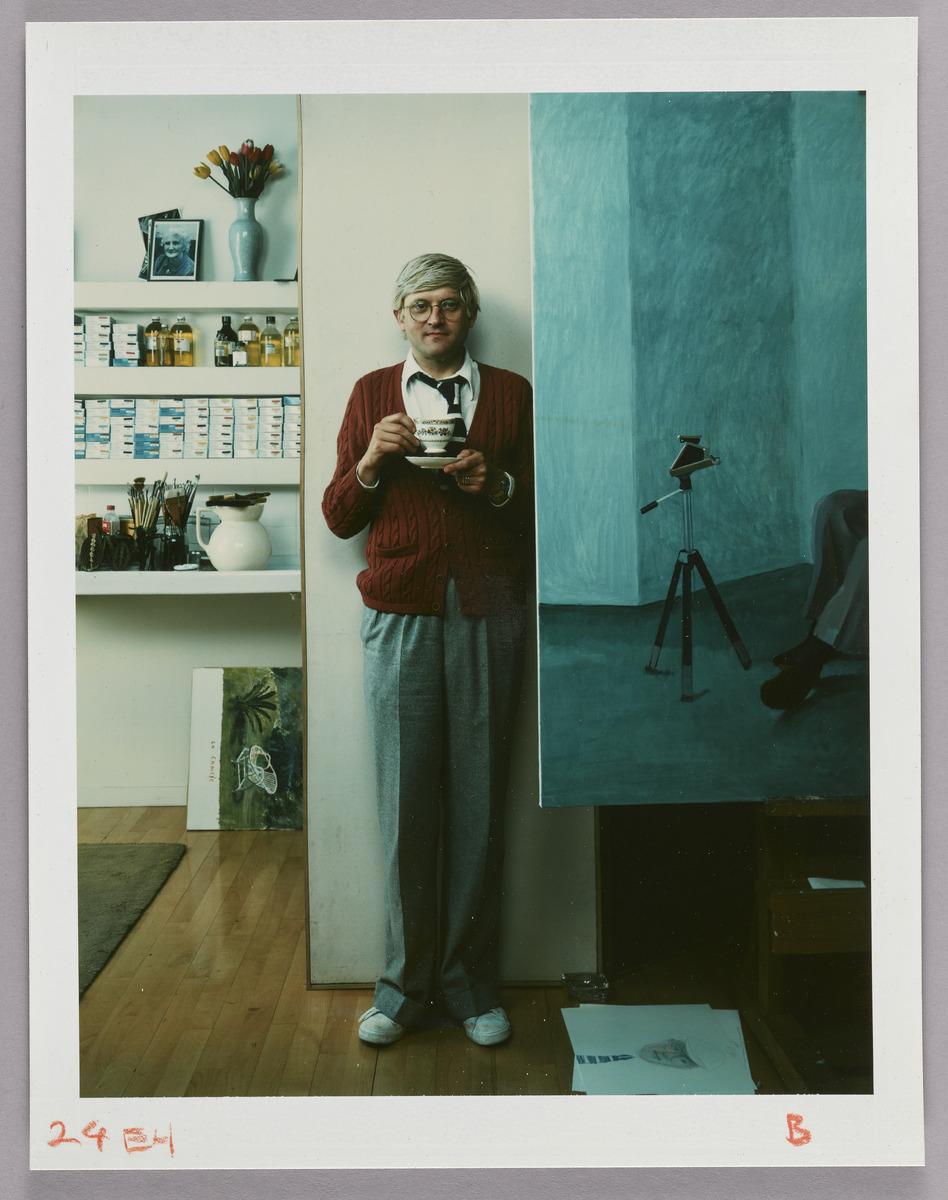
Arnold Newman. David Hockney, 1978. Colour instant print, Overall: 27.6 × 21.5 cm. Art Gallery of Ontario. Anonymous Gift, 2012. © Arnold Newman Properties/Getty Images [2026]. 2015/4115
The exhibition, I AM HERE: Home Movies and Everyday Masterpieces, was curated by Jim Shedden, Curator, Special Projects & Director, Publishing; Alexa Greist, Curator & R. Fraser Elliott Chair, Prints and Drawings at the AGO; and archivist, scholar and writer Rick Prelinger. Santa Monica Boulevard (1978-80) is no longer on view at the AGO.
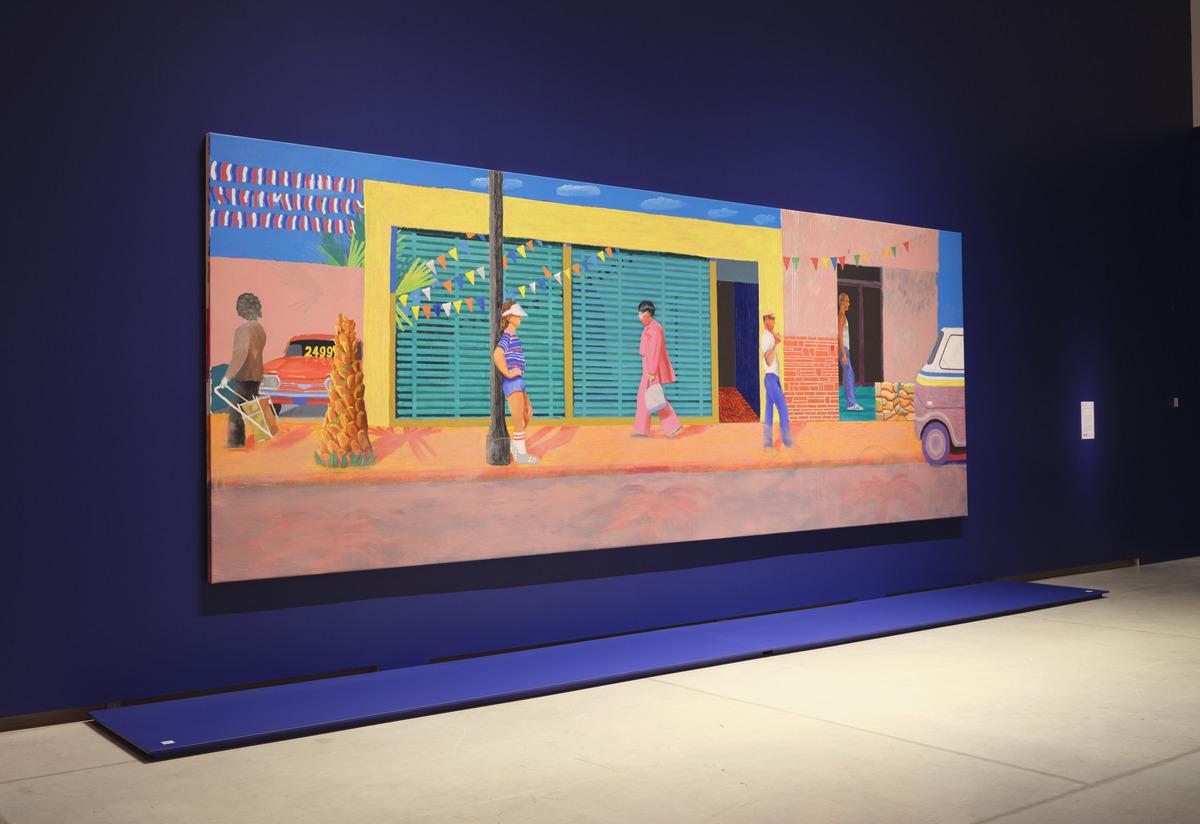
David Hockney. Santa Monica Boulevard, 1978–80. Acrylic on canvas, 218.44 x 609.6 cm. Collection The David Hockney Foundation. © David Hockney. Installation view, I AM HERE: Home Movies and Everyday Masterpieces, April 16 - August 14, 2022. Art Gallery of Ontario. Photo: Sean Weaver / AGO
![Keith Haring in a Top Hat [Self-Portrait], (1989)](/sites/default/files/styles/image_small/public/2023-11/KHA-1626_representation_19435_original-Web%20and%20Standard%20PowerPoint.jpg?itok=MJgd2FZP)