Jan 22, 2026
Robert Motherwell’s Open Expression
A work from the pioneering Abstract Expressionist’s Open Series is on view now at the AGO
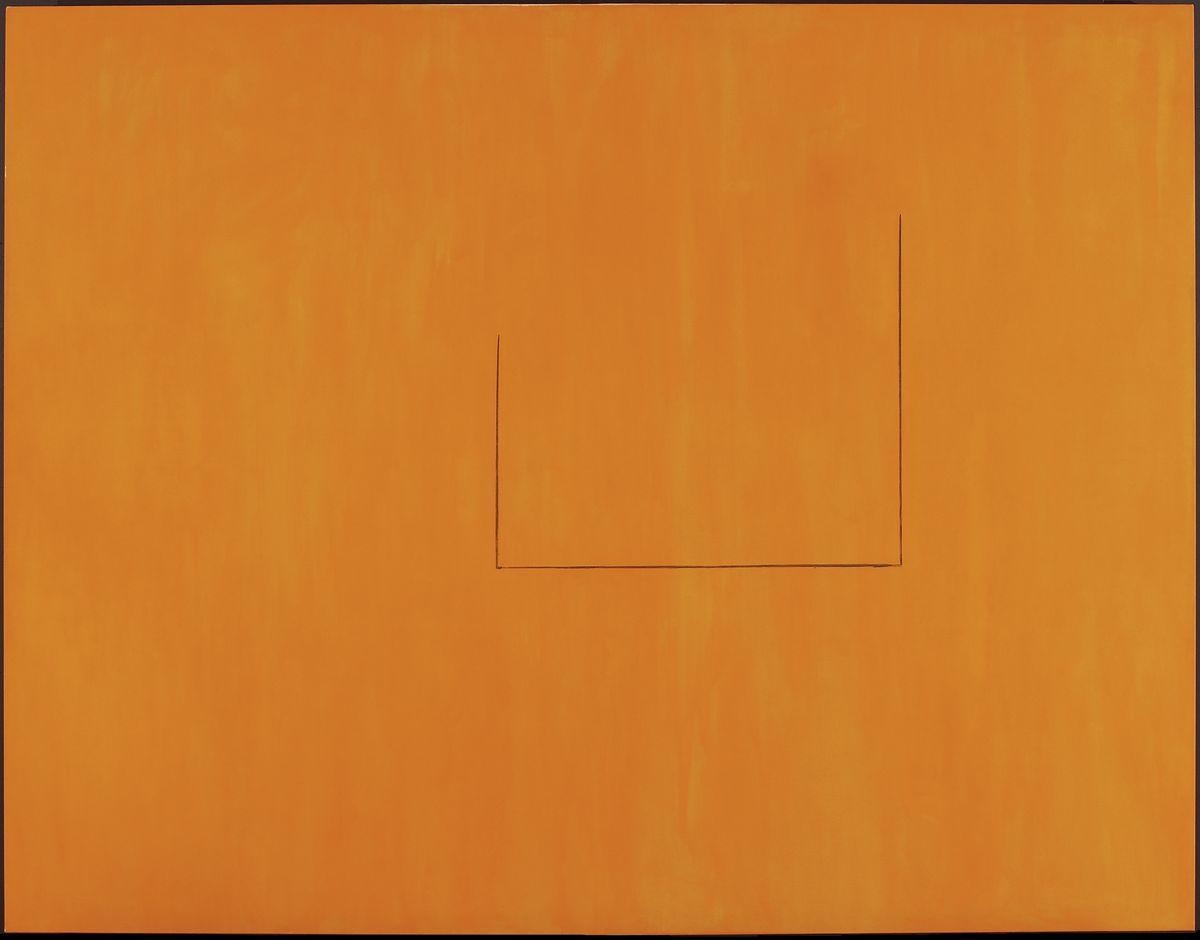
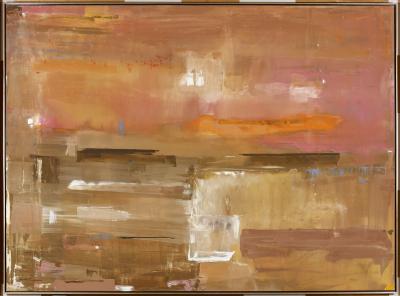
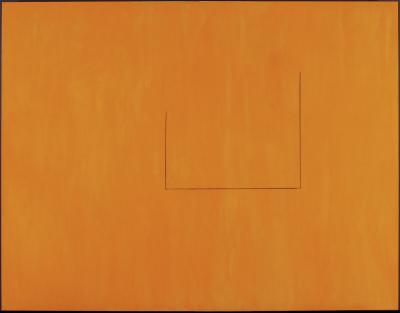
Robert Motherwell. Open No. 37A: In Orange, 1971. Acrylic and charcoal on canvas, Overall: 213.2 x 274.5 cm. Art Gallery of Ontario. Gift of Mr. and Mrs. Roger Davidson, Mr. Harris Davidson, Mr. Matthew Davidson in Honour of Mrs. Harry Davidson, 1983. © [2026] Dedalus Foundation, Inc. / Artists Rights Society (ARS), NY / CARCC Ottawa. 84/42.
“Art is an experience, not an object.” – Robert Motherwell
In March 1967, pioneering Abstract Expressionist Robert Motherwell (1915 - 1991) was hard at work in his New York City studio when he noticed something seemingly mundane, yet extraordinary. A recent edition of his series, Summertime in Italy, was leaning against a larger canvas primed with ochre. Struck by the proportions of this juxtaposition, Motherwell intuitively traced the outer edge of the smaller painting directly onto the larger canvas with charcoal, completing a new work. This pivotal moment sparked The Open Series; a group of paintings with over 100 variations that he would continue to explore for the rest of his career. On view now at the AGO, Motherwell’s Open No. 37A: In Orange (1971) offers a vibrant iteration of the years-long series.
Located on Level 4 of the AGO, currently on view as part of the exhibition Moments in Modernism, Open No. 37A: In Orange glows in its titular colour. The large rectangular canvas is textured with broad, vertical brushstrokes of orange paint on an ochre ground. In this particular version, 37th in the series, three charcoal lines roughly align with the painting’s outer edges – two equal in length, one shorter – which, if connected by a fourth line, would create a trapezoid. Situated just right of centre, the formation evokes a window, doorway, or potentially another plane beyond the canvas. Like most of Motherwell’s oeuvre, this work invites slow and contemplative analysis, leaving space for the viewer’s subjective lens.
Highlighting the diversity of the AGO’s modern art collection, the exhibition Moments in Modernism features seminal works from some of the most revered artists of the 20th century. Among them is Motherwell, a central figure in the American Abstract Expressionist movement of the 1940s and 1950s. Like his contemporaries, Motherwell’s work is defined by intuitive, gestural painting.
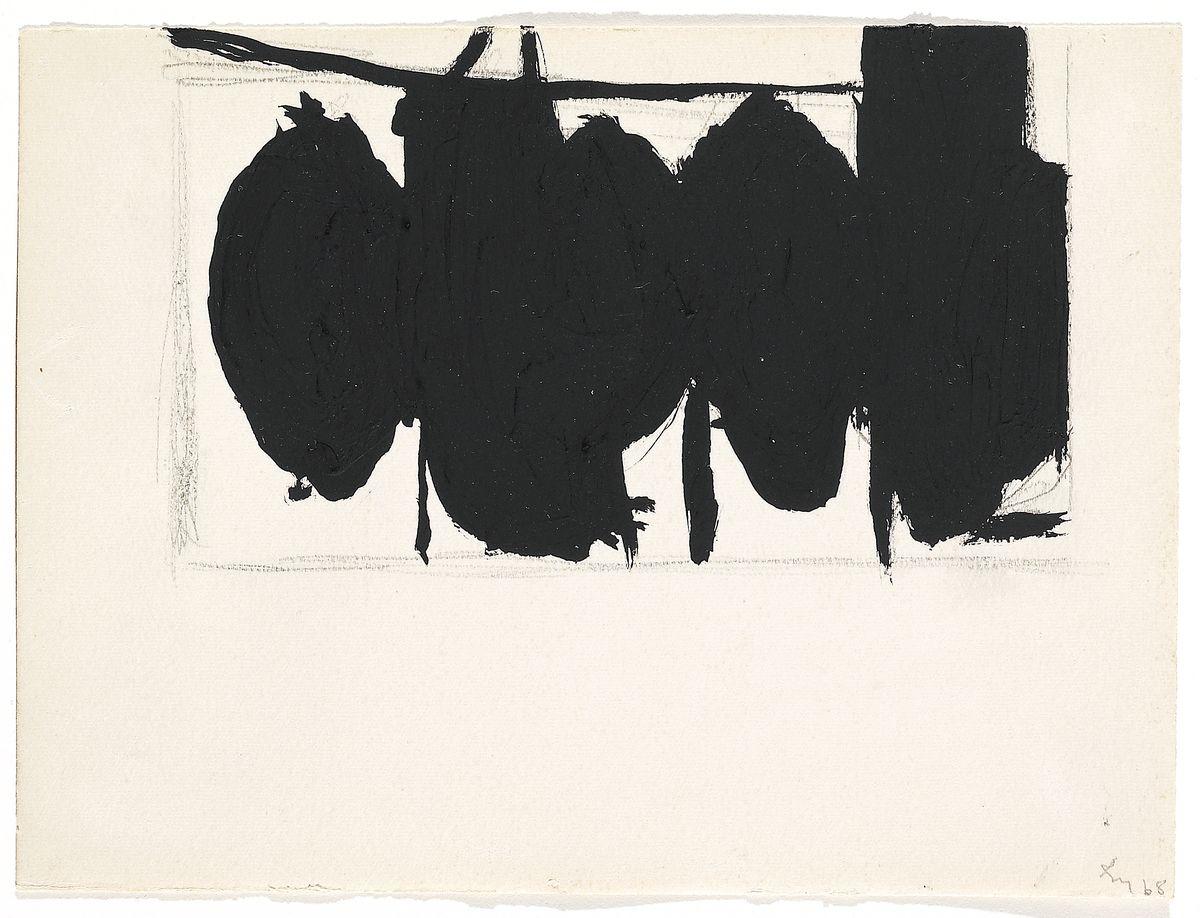
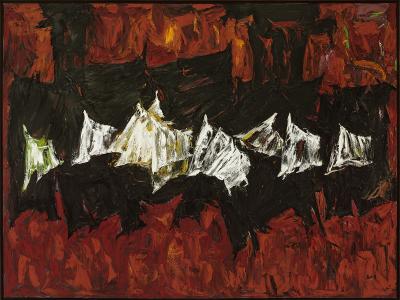
Robert Motherwell. Elegy to the Spanish Republic #110D, 1968. Acrylic and graphite on paper, Overall: 15.2 x 20.3 cm. Art Gallery of Ontario. Purchased with funds from an Anonymous Donor, with support from the Dedalus Foundation, 1998. © [2026] Dedalus Foundation, Inc. / Artists Rights Society (ARS), NY / CARCC, Ottawa. 98/60. Photo: AGO.
Born 1915 in Aberdeen, Washington to a wealthy family, Motherwell grew up in San Francisco. He studied painting briefly at the California School of Fine Art, but ultimately pursued philosophy, receiving a PhD from Harvard University. He moved to New York in 1940, where he developed a friendship with an influential group of European surrealist painters and became the protégé of artist Kurt Seligmann. Inspired by the concept of automatic drawing and poised to establish a new paradigm among Surrealist artists in New York, Motherwell became an instrumental figure in the Abstract Expressionism movement, also called the New York School. Alongside artists such as Mark Rothko and William Baziotes, and with the support of prominent art collector Peggy Guggenheim, this group of artists began regularly exhibiting their work in New York.
Known as a champion of Abstract Expressionism, Motherwell went on to lead an illustrious career and was celebrated globally. Along with the Open Series, his body of work includes his pivotal series, Elegies to the Spanish Republic, which he described as a lamentation or funeral song after the Spanish Civil War.
Open No. 37A: In Orange (1971) is on view now as part of the exhibition Moments in Modernism on Level 4 of the AGO.
Supporting Sponsor

Generous Support
Ira Gluskin & Maxine Granovsky Gluskin
Jay Smith & Laura Rapp
Marion & Gerald Soloway
Anonymous
![Keith Haring in a Top Hat [Self-Portrait], (1989)](/sites/default/files/styles/image_small/public/2023-11/KHA-1626_representation_19435_original-Web%20and%20Standard%20PowerPoint.jpg?itok=MJgd2FZP)