Presented by Signature Partner

Dec 15, 2025
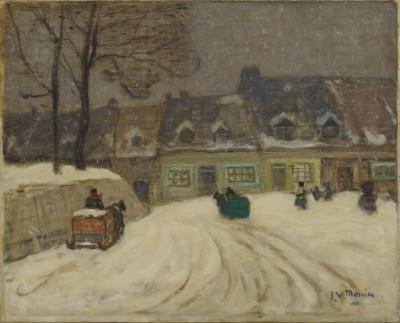
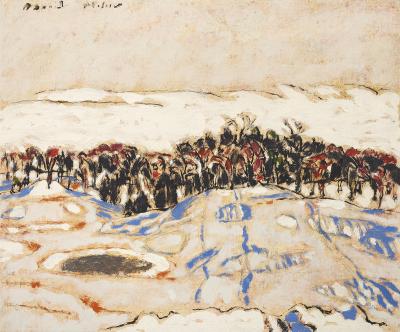
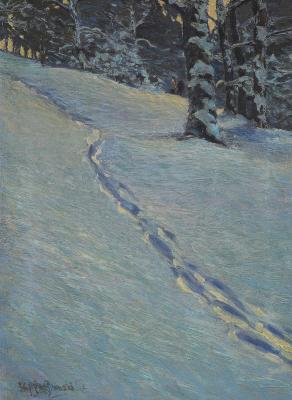
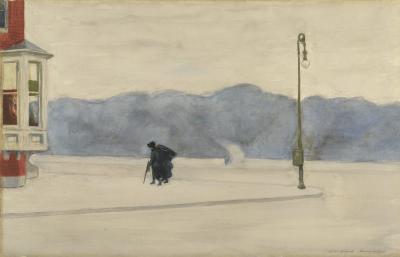
Morning After Snow, High Park
Group of Seven member J.E.H. MacDonald’s 1912 depiction of a snow-covered High Park trail
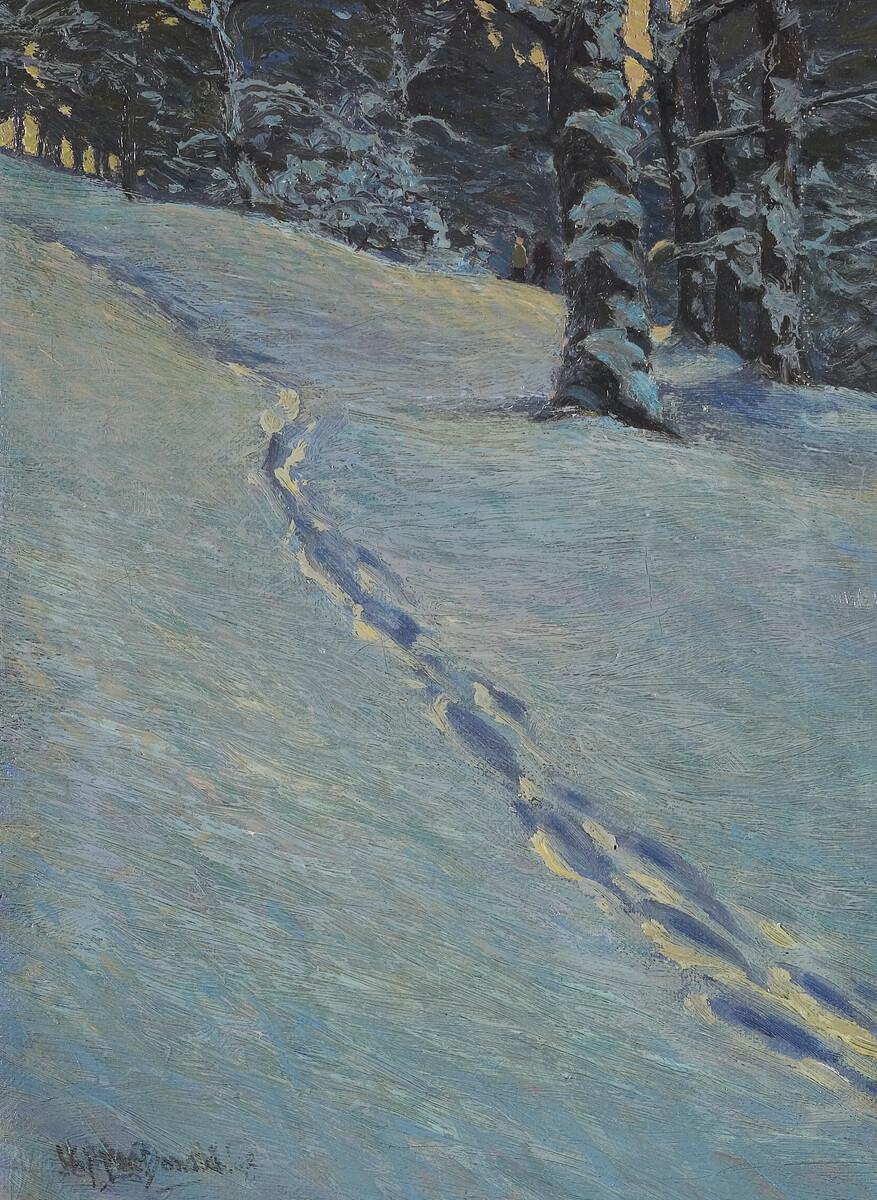
J.E.H. MacDonald. Morning after Snow, High Park, 1912. Oil on canvas, Overall: 36 x 25.7 cm. Art Gallery of Ontario. Gift of Mrs. W.D. Ross, Toronto, 1952. © Art Gallery of Ontario 52/12
High Park is Toronto’s largest and most well-known public park. When it was established in 1873, it was far less frequented by the city’s then 377,000 residents. By the turn of the 20th century, High Park was still mostly rustic wilderness with modest walking trails. Judging by the brushstrokes in J.E.H. MacDonald (1873 – 1932)’s 1912 painting, the park was possibly its most picturesque during the winter months.
Located on Level 1 of the AGO in the Carol Tanenbaum Gallery (gallery 116), J.E.H. MacDonald’s Morning After Snow, High Park (1912) is a serene depiction of a woodland clearing blanketed with fresh snow, newly walked over by two hikers in the early morning. The painting’s foreground is a wash of textured white snow, accented by the hiker’s long diagonal trail of footprints leading toward the top left corner of the canvas. As you shift your focus to the background, you’ll notice a cluster of snow-dusted brush, with a larger, more prominent tree trunk closer to the center of the canvas. Nestled in the distance, just to the left of that tree trunk, are the couple responsible for the footprints. MacDonald’s choice to situate the two figures deep within the cluster of trees – almost obscuring them – assures your gaze rests with the trail of footprints, rather than the hikers who made them.
Born in 1873 in Durham, England, James Edward Harvey MacDonald emigrated with his family to Hamilton, Ontario, at age 14. He began studying art right away, and by 16, his family had relocated to Toronto, where MacDonald was an active member of the Toronto Art Students League. In 1894, he took a job as a commercial designer at the prestigious art firm Grip Ltd. He kept his role for several years, during which he married his wife Joan and had his first child.
MacDonald’s career as an artist began in 1911 when he left his design role and moved with his family to Thornhill, Ontario, to focus on landscape painting. It was during this period that he would paint Morning After Snow, High Park. In 1912, he organized his first solo exhibition, which caught the attention of fellow artist and future Group of Seven member Lawren Harris (1885 – 1970). After striking up a friendship and working relationship, the two visited an exhibition of Scandinavian landscape art at the Albright Art Gallery in Buffalo, New York. Deeply inspired by the Post-Impressionist and Expressionist works they viewed, MacDonald and Harris began to envision a way this stylistic approach could be adapted to Canadian landscape art.
In 1920, MacDonald co-founded the Group of Seven with Harris, Franklin Carmichael (1890 – 1945), A.Y. Jackson (1882 – 1974), Franz (also known as Frank) Johnston (1888 – 1949), F.H. Varley (1881 – 1969), and Arthur Lismer (1885 – 1969). Their inaugural group exhibition of 121 landscape works was held at the AGO, and the group would later be lauded as representing the first major national Canadian art movement in history.
After working as an instructor of decorative art and commercial design at the Ontario College of Art (now OCADU) in 1921, he served as the school’s principal from 1928 until his death. MacDonald passed away in 1932 at the age of 59. The AGO holds many of MacDonald’s works in its permanent collection, among the most significant holdings of any institution.
Morning After Snow, High Park is on view now on Level 1 of the AGO in the Carol Tanenbaum Gallery (gallery 116).
![Keith Haring in a Top Hat [Self-Portrait], (1989)](/sites/default/files/styles/image_small/public/2023-11/KHA-1626_representation_19435_original-Web%20and%20Standard%20PowerPoint.jpg?itok=MJgd2FZP)