May 13, 2026
Emily Carr’s Inside a Forest II
In the early 1930s, Emily Carr began to focus primarily on painting the forests of the Northwest Coast
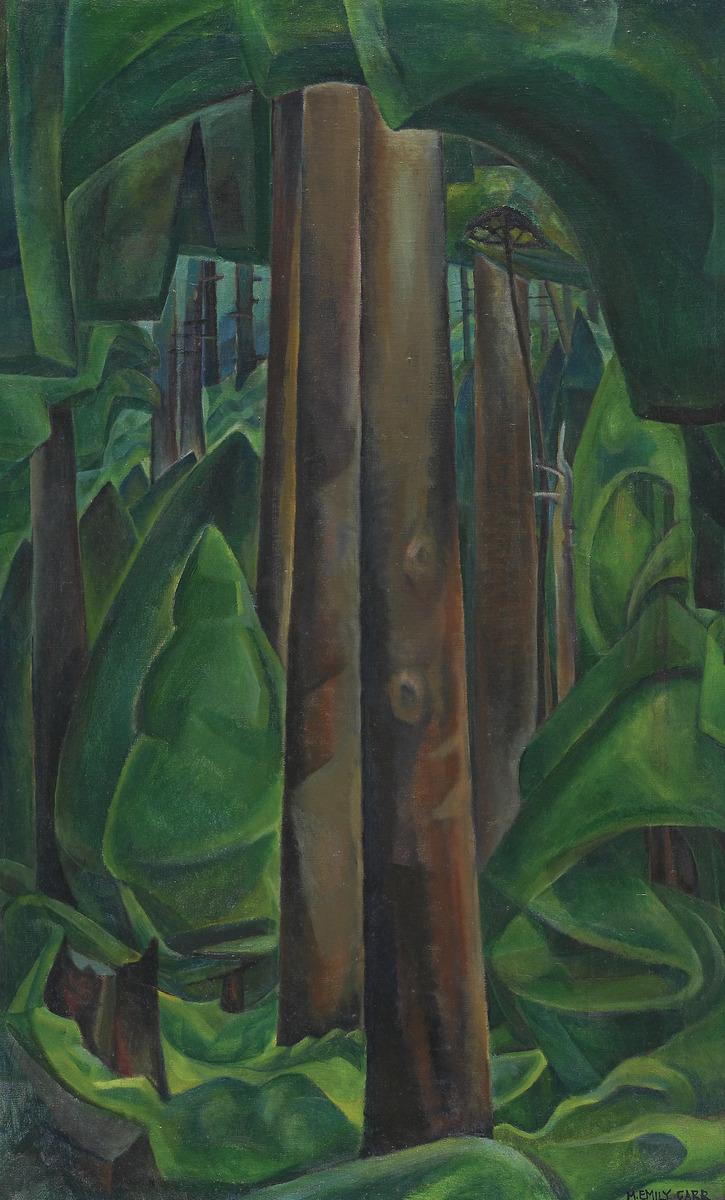
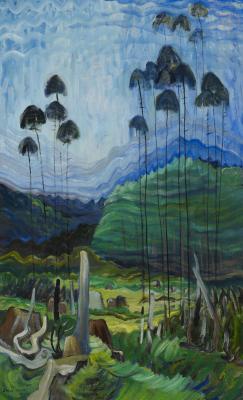
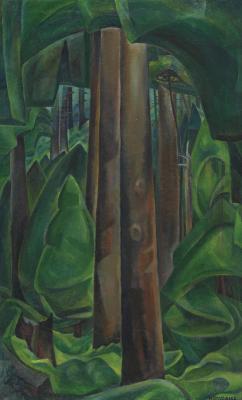
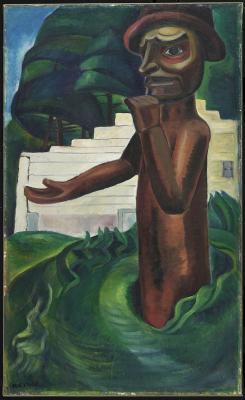
Emily Carr. Inside a Forest II, 1929-1930. Oil on canvas, Overall: 109.9 x 69.8 cm. Art Gallery of Ontario. Bequest of Charles S. Band, 1970. Photo © AGO 69/11
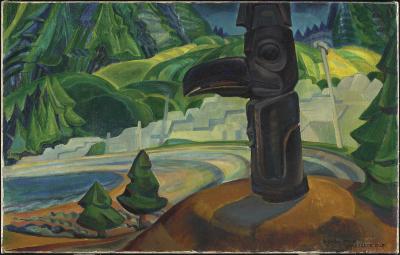
One could easily get lost in the lush green trees of this painting. Inside a Forest II (1929-1930) is one of several works on view exploring the landscapes of the Pacific Northwest by Emily Carr (1871-1945). Now on view on Level 2 of the AGO in gallery 211 are eight paintings by Carr that feature totem poles; the villages of Kwakwakaʼwakw, Haida, Wet'suwet'en, and Gitxsan nations; and the deep forests of the Northwest Coast, as seen in Inside a Forest II.
Born and raised in Victoria, British Columbia, Carr is best known for her depictions of the Indigenous cultures and landscapes of the Northwest Coast of her home province. After a trip to Alaska in 1907, Carr dedicated her practice to documenting Indigenous villages and totem poles in British Columbia, leaving a complex legacy. In the early 1930s, Carr began to primarily focus on rendering the province’s forests and skies. Inside a Forest II was created just on the cusp of this transition.
Carr’s paintings reflect the spirituality she felt within the nature of the Northwest Coast. She was once quoted as saying, “The woods are my cathedral,” believing that “The juice and essence of life are in them.” In 1933, she purchased a caravan that she named “the Elephant,” which allowed her to live remotely in the forest while she painted. As seen in Inside a Forest II, Carr’s mature style was a unique amalgamation of British, French, American, and Canadian Modernist influences. While no longer explicitly painting Indigenous subjects, Carr still drew inspiration from Northwest Coast Indigenous art styles; her depictions of solitary trees and towering trunks are reminiscent of the totem poles she previously painted.
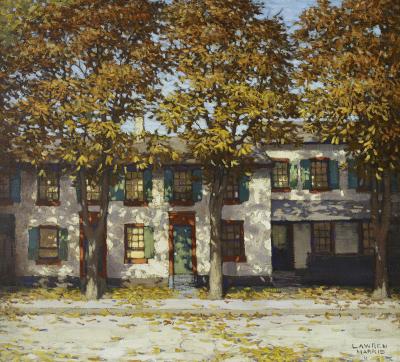
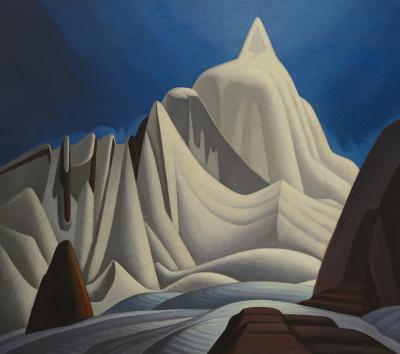
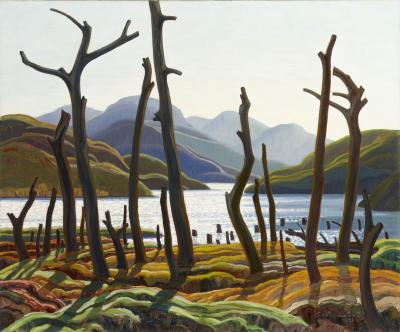
Carr’s shift to focusing on nature scenes was influenced by meeting the Group of Seven in 1927 during a trip to Toronto. Lawren Harris, who similarly saw spirituality in nature, particularly inspired Carr to explore her strong feelings for the Northwest Coast through a different subject matter. He once wrote in a letter to Carr, “The totem pole is a work of art in its own right... But how about seeking an equivalent for it in the exotic landscape of the Island and coast, making your own form and forms within the greater form?”
While Carr was not officially a member of the Group of Seven, she was one of the few women who exhibited with them, and Harris gave her the nickname “Mother of Modern Art in Canada.” Carr and the Group of Seven are often credited with bringing the Modern art movement to Canada.
Visit Inside a Forest II alongside seven other paintings by Carr, on view on Level 2 of the AGO in gallery 211.
![Keith Haring in a Top Hat [Self-Portrait], (1989)](/sites/default/files/styles/image_small/public/2023-11/KHA-1626_representation_19435_original-Web%20and%20Standard%20PowerPoint.jpg?itok=MJgd2FZP)