Apr 1, 2026
Pierre Louis Alexandre, 19th Century Top Model
A newly acquired portrait at the AGO illuminates the story of a 19th-century life model.
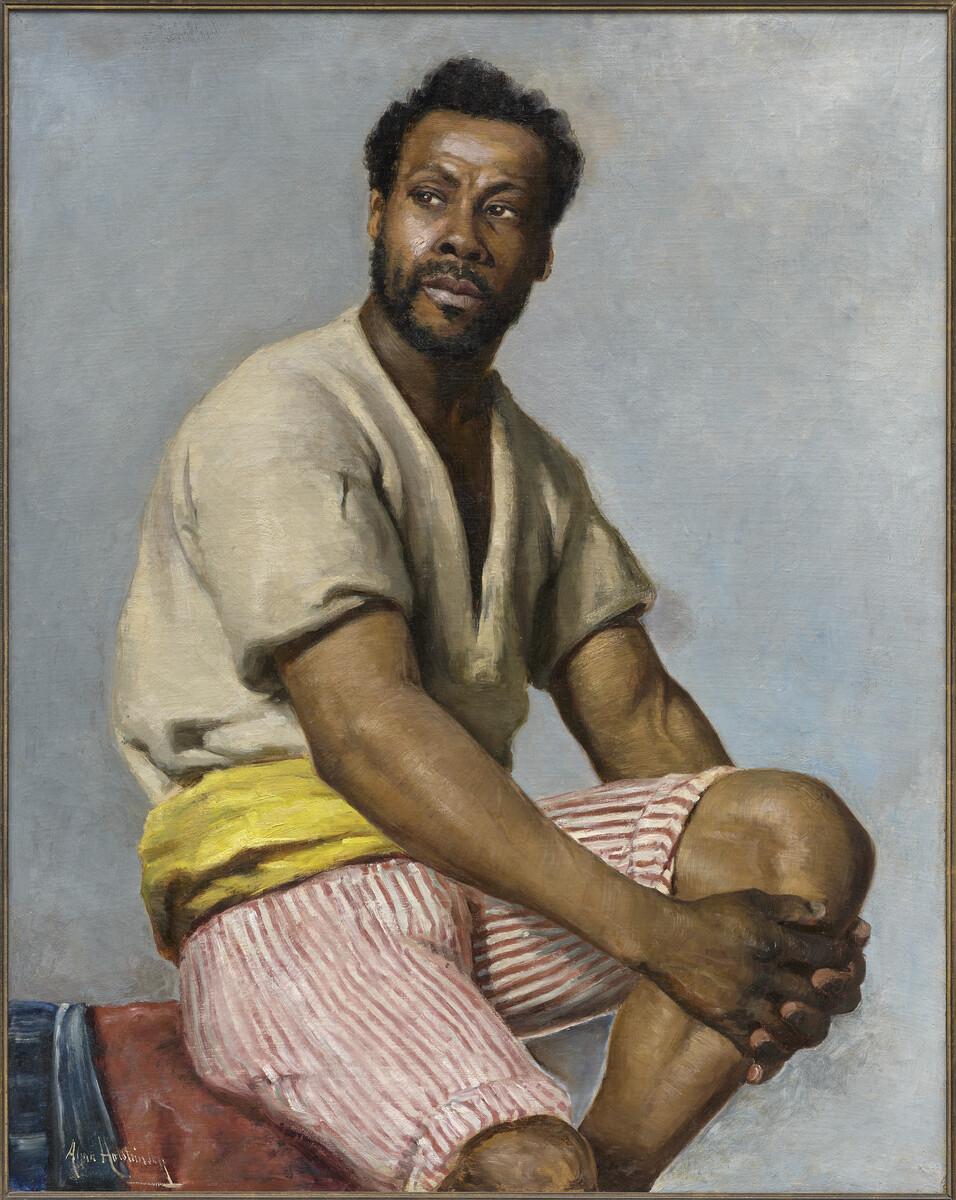
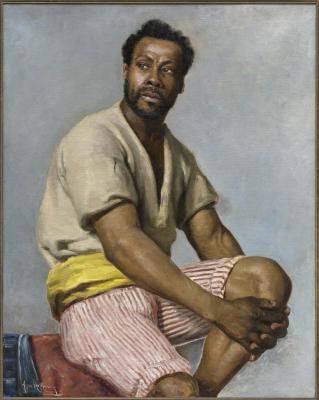
Alma Holsteinson. Portrait of Pierre Louis Alexandre (1844-1905), c. 1879-80. Oil on canvas, Overall: 92 × 74 cm. Art Gallery of Ontario. Purchase, with funds by exchange from the R. Fraser Elliott Estate, 2025. Photo © AGO. 2025/1061
It’s 1879 in Stockholm at the Royal Swedish Academy of Fine Arts, and a studio portraiture class is in session. A group of women art students assemble in a circle, readying their painting stations, eager to construct an interpretation of today’s subject: Pierre Louis Alexandre. A life model who unassumingly left his mark on history, he was likely the most frequently depicted Black sitter in pre-20th-century European art. One of the paintings created that day has recently found a home in the AGO Collection. Portrait of Pierre Louis Alexandre (1879-80) by Swedish artist Alma Holsteinson is currently on view on Level 1 of the AGO.
Completed by Holsteinson during her time as a student at the Royal Swedish Academy of Fine Arts, this arresting portrayal of Alexandre is close to one metre in height. He sits casually with both hands cradling his left knee, directing a contemplative gaze over his right shoulder. Rather than casting Alexandre in an imagined setting, Holsteinson accentuates his presence using a background of blues and greys reminiscent of a slightly overcast sky.
He wears a beige, short-sleeved shirt made of thick fabric, snugly tucked into a yellow sash at the waist, and red-striped shorts rolled above the knee. Through the contours and pronounced musculature of Alexandre’s arms and legs, Holsteinson illustrates his well-toned physique. Her careful attention to detail breathes life into the canvas.
From French Guiana to Stockholm
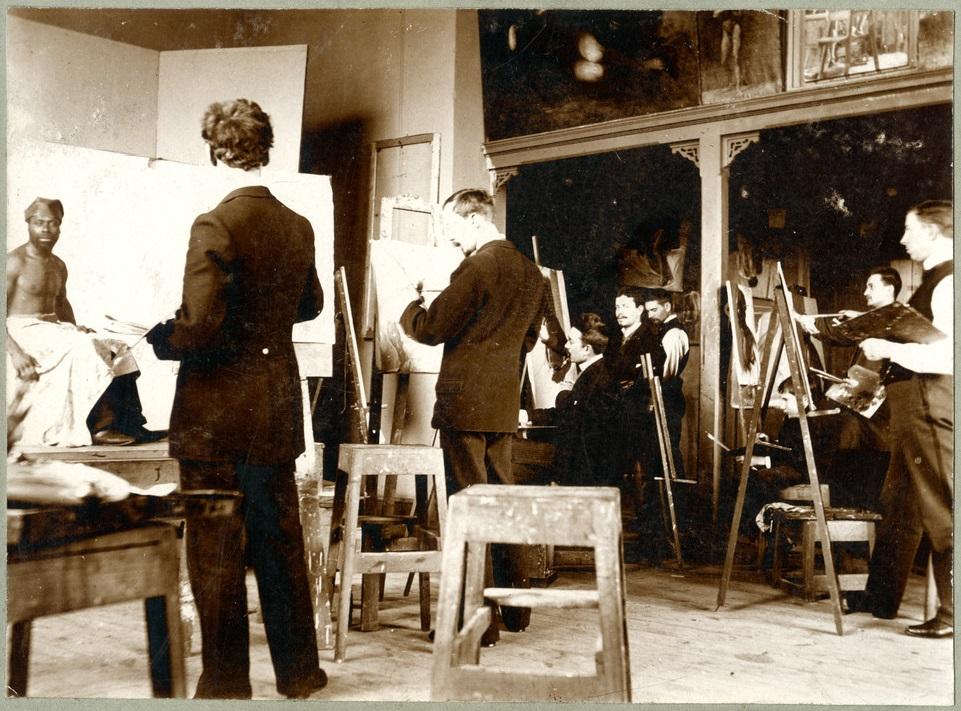
Studio photo of the model Pierre Louis Alexandre at the Royal Academy of Fine Arts in Stockholm, Sweden, c. 1890. Emil Österman's archive, Eskilstuna City Museum
For a Black man in Europe during the late 19th century, earning income as a life model was far from conventional. Although the system of chattel slavery had been abolished in recent decades, Black communities were still navigating immense hardship and marginalization. How, then, did Alexandre wind up being paid handsomely to pose for dozens of Sweden’s leading artists?
Alexandre was born in Cayenne, French Guiana, in 1844. Little is known about his youth, but at some point, he fled the country – potentially as a fugitive slave or newly freed man – aboard a ship bound for America. Historical records indicate he docked in New York City, where he stayed for an unknown period before once again setting sail on another vessel. After crossing the Atlantic toward the city where he would spend the rest of his life, Alexandre landed in Stockholm when he was around 19. He then secured a role tending to the ports as a dockworker, which would be his main source of income for roughly the next 15 years.
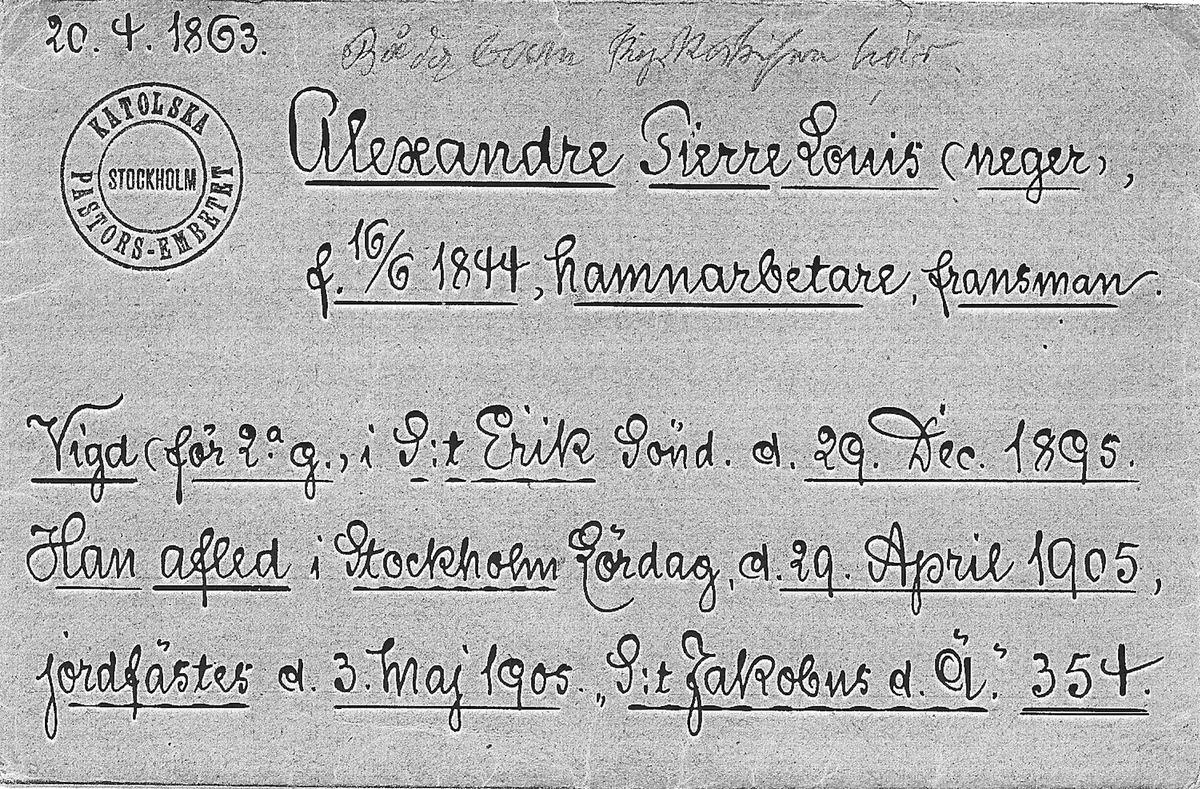
Pierre Louis Alexandre registration card from the Catholic parish of St Eric in Stockholm, Sweden
Winters in Stockholm were brutal, often leaving port waters frozen and dockworkers unemployed until spring. This was a source of adversity for most, but in 1878, Alexandre’s seasonal layoff turned into a pivotal opportunity, the origin of which remains unclear. He was hired that winter as a life model at the Royal Swedish Academy of Fine Arts and returned to “moonlight” as a sitter for at least 9 of the 15 subsequent years between 1879 and 1903. Alexandre’s compensation would have likely doubled that of a dockworker’s pay, and he was able to work indoors, which surely afforded him a higher quality of life. During his years modelling at the Academy and for private studios on occasion, he was depicted by a host of well-known Swedish artists, including Anders Zorn, Oscar Björck, and Karin Bergöö Larsson.
“Alexandre’s life reflects a turning point in history,” says Caroline Shields, Curator of European Art at the AGO, who spearheaded the acquisition. “His ancestors were trafficked from Africa and enslaved in South America by force; his own journey across the Atlantic was by choice. By bringing this outstanding painting to the AGO, we build bridges across our collections, growing ever closer to representing a more expansive history of Europe and the global interconnectedness of the African Diaspora.”
The Brush Behind the Portrait
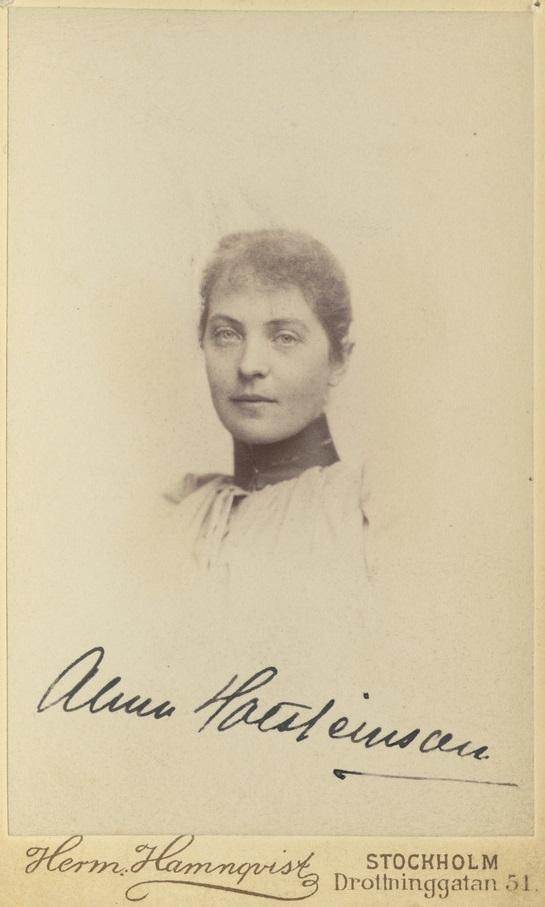
Herman Hamnqvist, Portrait of Alma Helena Holsteinson, 1890. KB Digital, ID 004189432.
Interestingly, more is known about Alexandre than the artist behind the AGO’s recently acquired portrait. Alma Holsteinson was born in 1859 to a mining family in Norberg, Sweden. At the age of 19, she enrolled at the Royal Swedish Academy of Fine Arts, where she studied from 1878 to 1884. Such access to training at a national fine arts academy was still quite progressive—by comparison, the Academy of Fine Arts in France didn’t admit women students until 1897. This afforded Holsteinson a rare opportunity at the Academy. Over the course of her career, she received recognition for her portraits, completed in oil and pastel, and periodically exhibited works at the Art Association for Southern Sweden. This acquisition by the AGO marks the first painting by Holsteinson to enter a major museum collection outside of Scandinavia.
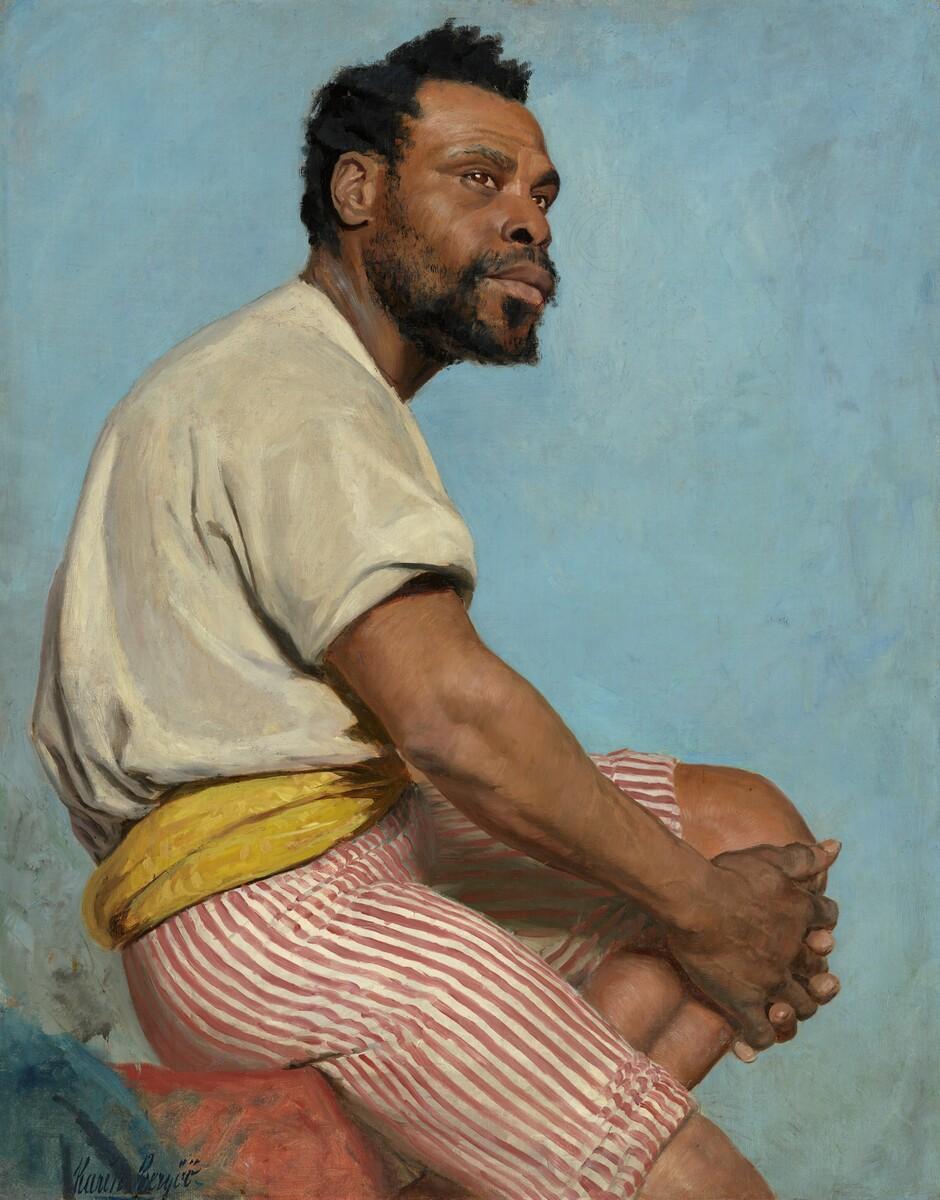
Karin Bergöö Larsson, Pierre Louis Alexandre, 1879 - 1880 .Oil on canvas, mounted on board, overall: 92.2 × 73.5 cm. National Gallery of Art, Washington. Gift of Funds from Laura and John Arnold, Virginia Cretella Mars, and Maria Elena Weissman. 2024.6.1. Courtesy National Gallery of Art, Washington
Portrait of Pierre Louis Alexandre was created sometime during the first two years that Holsteinson and Alexandre were a part of the Academy’s artistic community. It's the product of a studio portrait session, in which Holsteinson sat among a group of other students with easels, likely all women, painting Alexandre as he posed. One of those fellow students was Karin Bergöö Larsson, whose portrait of Alexandre in identical attire and position was acquired by the National Gallery of Art, Washington, in 2024. The angle of Bergöö Larsson’s portrait suggests she was seated directly to Holsteinson’s left during the session.
Legacies
Alexandre passed away from tuberculosis in 1905 at 60 years old. He was married twice and survived by his second wife and two children. Research into his life and legacy as a portrait model began in the 1970s and is continued today by many art historians.
Holsteinson never married, and a 1910 city census recorded her presence in a hospital for declining mental health. This may explain why so little of her work and other documentation of her life survives today. A small number of her works are held by major Swedish museum collections, including the Nationalmuseum in Sweden, and are defined by their sophistication and rigour.
For Shields, Portrait of Pierre Louis Alexandre is the distillation of an extraordinary moment. “Coming from a mining family and encountering Alexandre at the Academy,” she reflects, “Holstein knew the daily toll of physical labour. Perhaps this understanding accounts for her deeply empathetic portrayal. While the artist and the model led quite different paths through life, this painting survives as a marker of the moment when they intersected.”
She hopes that for AGO visitors, “Holsteinson’s representation of Alexandre remains so present, so immediate, that it seems as though he could walk out of the painting and into our world today.”
Portrait of Pierre Louis Alexandre (1879-80) by Alma Holsteinson is on view in the Sarah and David Macdonald Gallery (gallery 130) on Level 1 of the AGO.




![Keith Haring in a Top Hat [Self-Portrait], (1989)](/sites/default/files/styles/image_small/public/2023-11/KHA-1626_representation_19435_original-Web%20and%20Standard%20PowerPoint.jpg?itok=MJgd2FZP)