Jul 9, 2026
Modernism, She Said
Four Canadian artists who strove to be seen and in turn, changed how we see this place
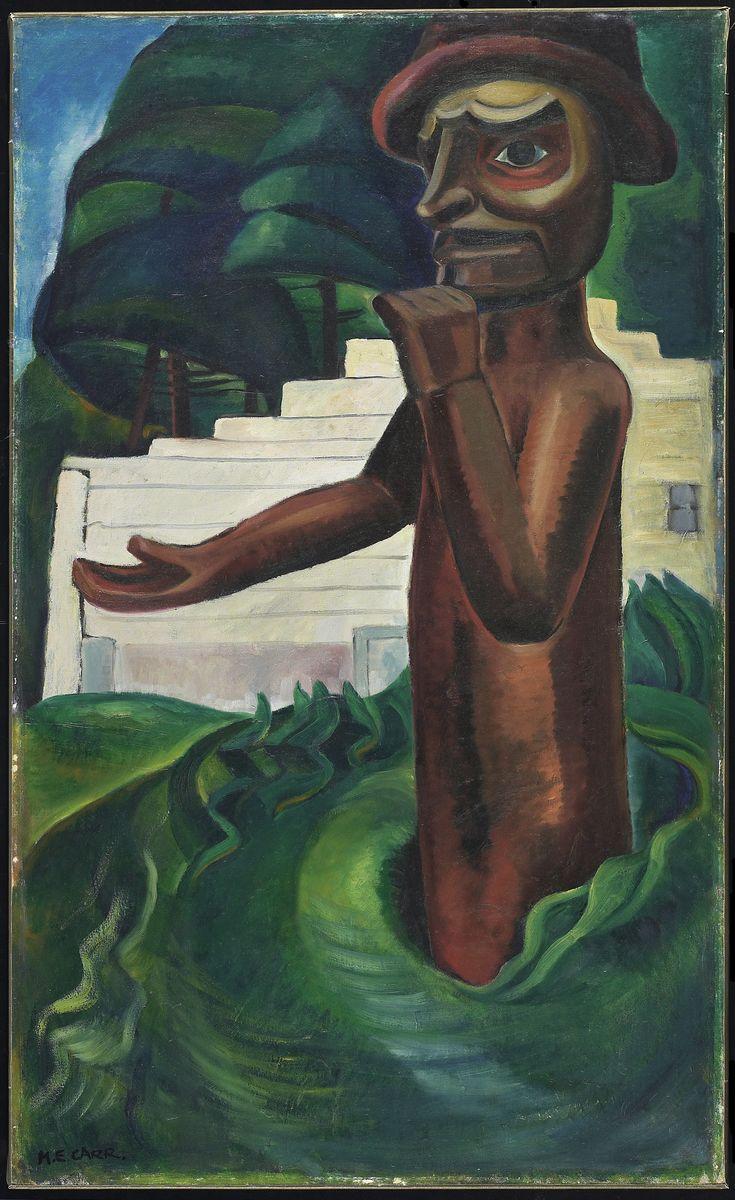
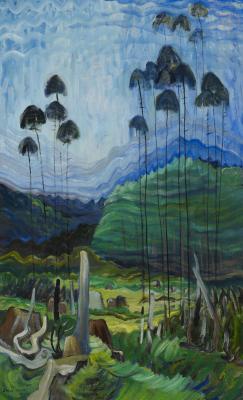
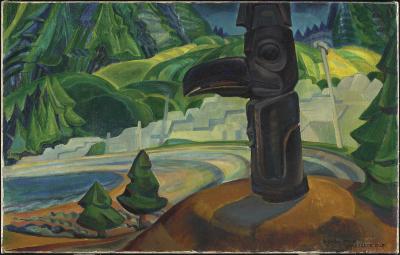
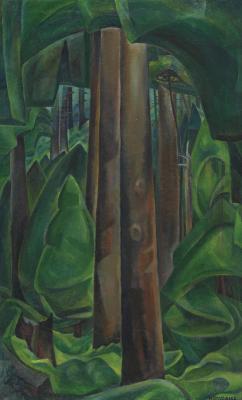
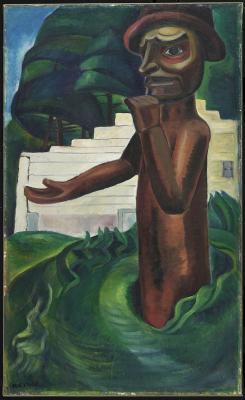
Emily Carr. Potlatch Welcome, c. 1928. Oil on canvas, Overall: 110.3 x 67.2 cm. Art Gallery of Ontario. Bequest of Charles S. Band, 1970. Photo © AGO. 69/120
Throughout the 1920s, artists across Canada sought new ways to create an art that was uniquely of this place. Even though Canadian women had yet to achieve legal personhood, and the Royal Canadian Academy of Arts had yet to grant full membership to any female artist, women artists were slowly making themselves seen in galleries and museums across the country. In 1922, the Art Gallery of Toronto (as the AGO was then known) hosted its first one-woman show, a solo exhibition by Mary Heister Reid (albeit in memoriam). In 1928, the sixth exhibition by the Group of Seven saw the debut of new paintings by Montreal’s Prudence Heward.
Across Canada, women artists strove to put their art on display, transforming in the process how we see this place and ourselves. On view this summer at the AGO is a trio of intimate exhibitions, featuring acclaimed works by four women who achieved just that.
Elizabeth Wyn Wood
On view on Level 2 in the Jennings Young Gallery (gallery 231).
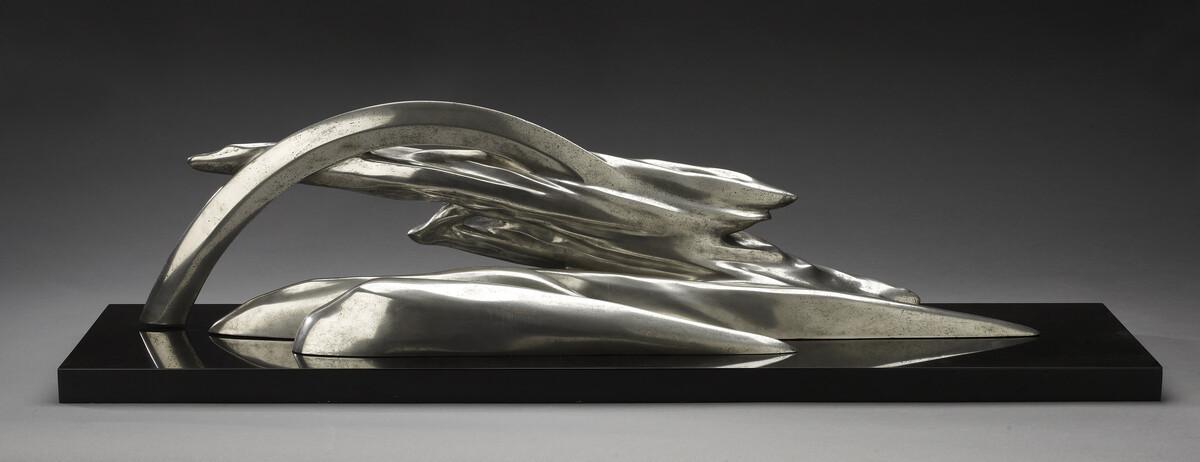
Elizabeth Wyn Wood. Reef and Rainbow, 1928-c. 1935. Cast tin on polished marble base, Overall: 24.8 × 25.2 × 96 cm. Art Gallery of Ontario. Gift from the Albert H. Robson Memorial Subscription Fund, 1950. Photo © AGO. 49/54
Ontario artist Elizabeth Wyn Wood (1903–1966) is one of the many women artists who charted her own path into the Canadian wilderness during the 1920s and '30s. On view now, as part of the exhibition, Elizabeth Wyn Wood, Reef and Rainbow (1928 - 1935) reflects both her intimate knowledge of Georgian Bay and its geography, as well as her interest in unique materials. Cast in tin, Wyn Wood’s ‘noble metal,’ this sculpture, she wrote, was a “portrait of a glaciated rock reef,” and sits alongside Northern Island (c. 1927), a gold-plated bronze form of a windswept pine of similar dimensions. Sculpture, Wyn Wood described in 1935, was far more than imitation. “Sculptural form is not the imitation of natural form any more than poetry is the imitation of natural conversation... While a piece of sculpture may contain visual forms with which we are acquainted by daily experience, it is essentially a design worked out by means of the juxtaposition of masses in space, just as poetry is a design wrought by the sounds of words in time."
Emily Carr
On view on Level 2 (gallery 211).
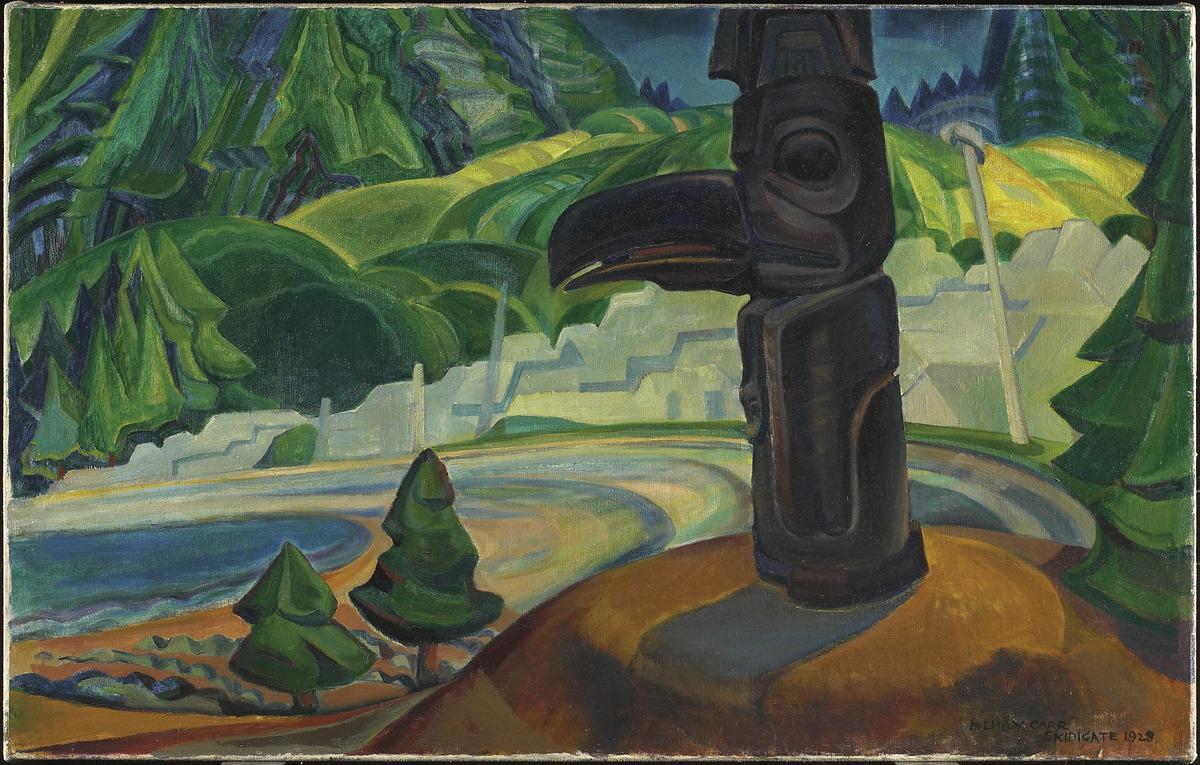
Emily Carr. Skidegate, 1928. Oil on canvas, Framed: 91.7 x 132.2 cm. Art Gallery of Ontario. Gift from the J.S. McLean Collection, by Canada Packers Inc., 1990. Photo © AGO. 89/781
Frustrated by her lack of commercial success, by the early 1920s, British Columbia painter Emily Carr (1871–1945) had given up. For 15 years she did not paint. That is until 1927, when she emerged as part of an exhibition at the National Gallery of Canada. One of nine Carr paintings currently on view, Skidegate (1928) is a hallmark of an artistic revival that began in 1928, which saw her journeying up and down the West Coast of British Columbia. Her intention, she declared, was to “try and make as good a representative collection of those old villages and wonderful totem poles as I could, for the love of the people and the love of the places and the love of the art; whether anybody liked them or not... I painted them to please myself in my own way, but I also stuck rigidly to the facts because I knew I was painting history.” While her legacy remains complex, and her work has been widely criticized for the colonial imaginary it presents, the power of her unique vision remains, continuing to influence generations of West Coast artists.
Remade: Clay, Plaster, Stone
On view on Level 2 in the Mary & Harry Jackman Gallery (gallery 238).
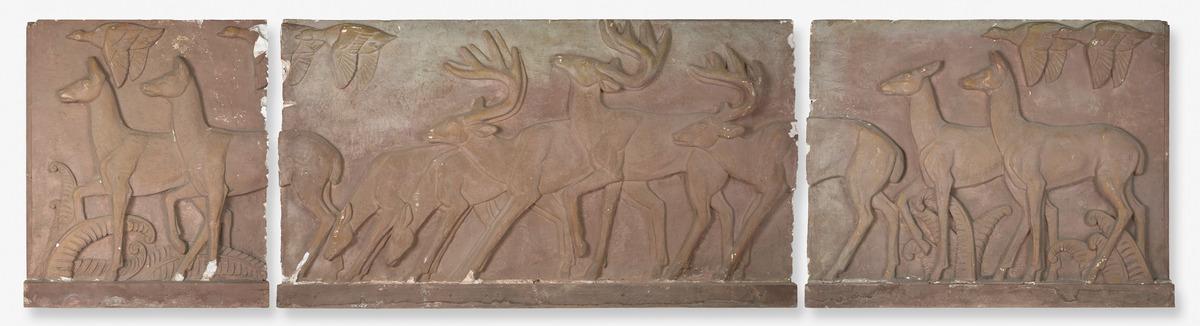
Frances Norma Loring. Deer Panel, c. 1939-1941. Tripartite painted plaster. Art Gallery of Ontario. Gift of the Estates of Frances Loring and Florence Wyle, 1983. © Art Gallery of Ontario.
One of Canada’s first successful female sculptors, Frances Loring (1887–1968) arrived in Toronto in 1913, and in 1928, with her creative partner Florence Wyle, co-founded the Sculptors Society of Canada with Wyn Wood, Emanuel Hahn, Alfred Laliberté and Henri Hébert. The head office of the SSC was the pair's studio, a converted Sunday school building known as “The Church.” Together they strove to raise the profile of Canadian sculpture, foster young talent, establish professional standards for artists, and create exhibition opportunities independent of older, academic European constraints. Featuring a selection of rarely seen sculptures by Loring and Wyle, Remade: Clay, Plaster, Stone highlights their stylized and simplified approach to both human and natural forms. As part of the exhibition, the three-panel plaster Deer Panel (c. 1939–1941) is being exhibited for the first time since 1944. “To be a sculptor,” Loring said, “one must understand carpentering, and be two or three kinds of mechanic. Besides that, one must have no end of stick-at-it-iveness.”
These exhibitions will be on view through the fall of 2026.



![Keith Haring in a Top Hat [Self-Portrait], (1989)](/sites/default/files/styles/image_small/public/2023-11/KHA-1626_representation_19435_original-Web%20and%20Standard%20PowerPoint.jpg?itok=MJgd2FZP)