Jul 9, 2026
Paul Anthony Smith’s Carnival Picotage
On view now at the AGO, the Jamaican artist’s Midnight Blue explores hybrid identities
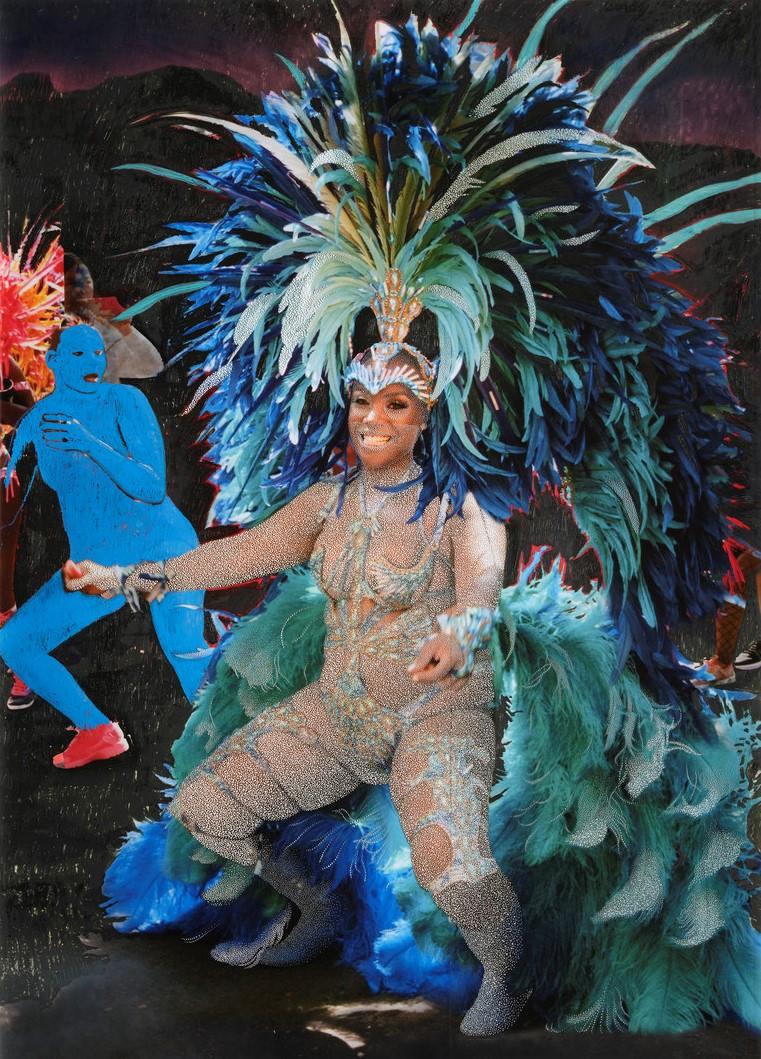
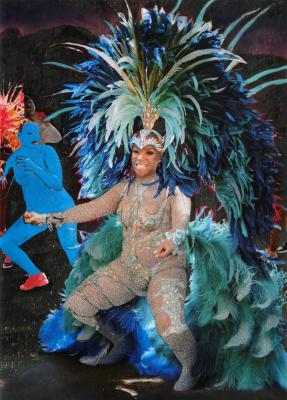
Paul Anthony Smith. Midnight Blue, 2020. Unique picotage on inkjet print, coloured pencil, spray paint on museum board, Framed: 247.7 × 177.3 × 7.1 cm. Art Gallery of Ontario. Purchase, with funds from Friends of Global Africa and the Diaspora, 2022. © Paul Anthony Smith. Courtesy of Jack Shainman Gallery, New York. 2022/12
What is picotage? Coined by Jamaican artist Paul Anthony Smith, the term describes the signature technique used in his photo-based practice. By meticulously puncturing tiny holes in large-scale printed photographs and further manipulating the image with coloured pencil and spray paint, Smith illustrates the complexities of the post-colonial Black experience. On view now at the AGO, his vibrant work, Midnight Blue (2020), uses the colourful pageantry of Carnival to explore Caribbean identity.
Over 8 feet in height, Midnight Blue features a Carnival masquerader in traditional costume, crouched in a dancing position. Her exuberant smile is accented by a grand feathered headdress and tail, with the plumage melding together to form a majestic silhouette. Demonstrating the precision of Smith’s picotage technique, the masquerader’s complete body is covered in tiny puncture marks, intentionally obscuring her figure. By carefully manipulating the size and angle of each hole, Smith creates a layer of textured patterns along the contours of her body and face. Behind her left shoulder is an otherworldly blue creature appearing to be engaged in Carnival festivities.
Hand painted by Smith, Midnight Blue’s titular figure is derived from the Trinidadian Carnival character, the Blue Devil. Dating back to the late 18th century, the emancipatory practice of masquerade began when enslaved Africans in Trinidad and Tobago started using the occasion of European pre-Lenten celebrations to covertly enact their cultural traditions. This included a variety of masking, drumming, dancing and the satirical lampooning of plantation owners. Originating in the Trinidadian town of Paramin, the Blue Devil character is used to taunt masqueraders and passersby during Carnival, prompting them to remove their inhibitions and engage in revelry and resistance.
The image of a present-day masquerader, obscured by picotage, under the gaze of a painted Blue Devil is emblematic of the themes often presented in Smith’s work. The assortment of layers and textures on Midnight Blue’s surface are a powerful reflection of hybrid Black identities that span time and place.
Born in Jamaica, Smith lives and works in New York City. He has a BFA from the Kansas City Art Institute. His work is held in numerous public collections and has been featured in major museum exhibitions across America and Europe.
Midnight Blue was first created by Smith for the 2021 AGO exhibition, Fragments of Epic Memory. It is now on view as part of the focused presentation of works, Critical Views: Recent Acquisitions by the Department of Arts of Global Africa & the Diaspora, on Level 2 of the AGO in the R. Samuel McLaughlin Gallery (gallery 201). Additionally, on view for the first time, alongside this work by Smith, are recently acquired works by Che Lovelace, Sahara Longe, Sandra Brewster, Kimani Beckford and Natia Lemay.
![Unknown photographer, Chillin on the beach, Santa Monica [Couple on beach blanket]](/sites/default/files/styles/image_small/public/2023-04/RSZ%20WMM.jpg?itok=nUdDiiKr)