Apr 21, 2026
Conserving 25 Years of Photography at the AGO
Katy Whitman, the AGO’s Conservator of Photographs, discusses looking after 70,000 photographs
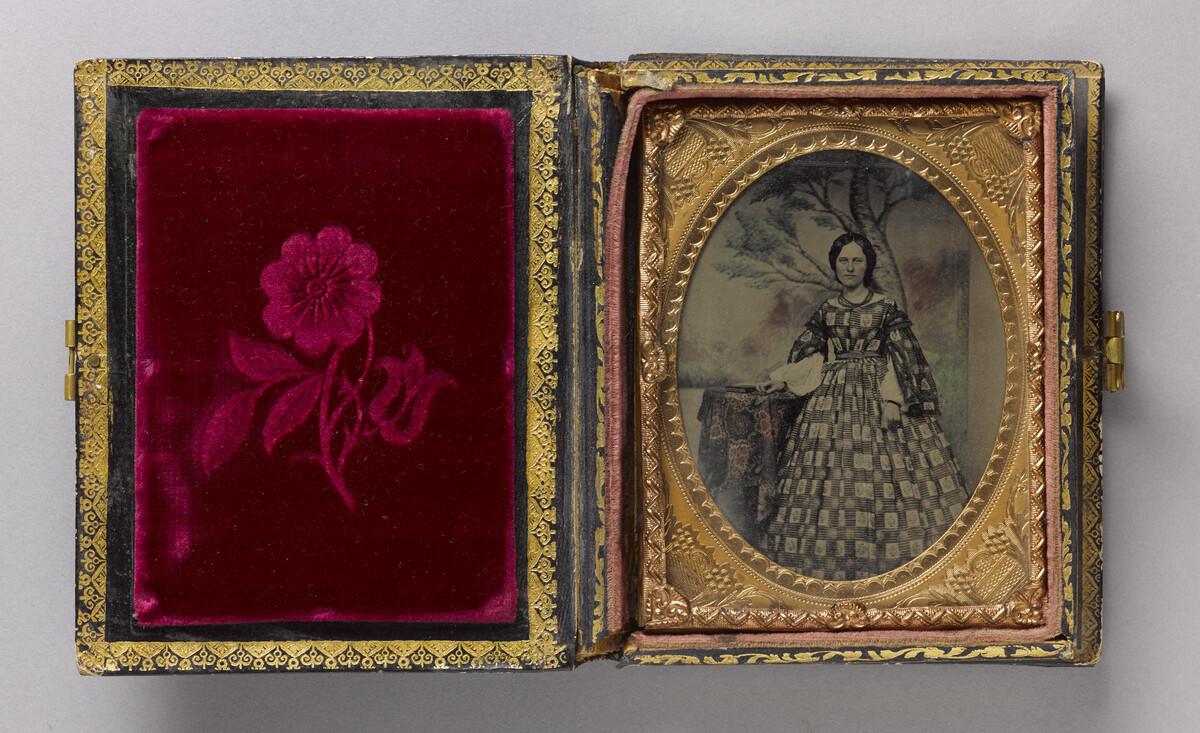
British or French. [Woman in patterned dress, standing in front of painted landscape backdrop], 1850s-1860s. Ambrotype: quarter plate with applied colour, in leather and wood book-style case with mother of pearl inlay and gilt, Case: 10.5 × 12.7 cm. Art Gallery of Ontario. Purchase, donated funds in memory of Eric Steiner, 2016. Photo © AGO. 2016/162
After two decades of advocacy, the AGO officially established its photography department in 2000. Since then, the AGO’s photography collection has grown to over 70,000 works.
Every one of these works falls under the care of Katy Whitman, Conservator of Photographs, who has been with the AGO since 2007. Recently, Whitman helped prepare a selection of 94 works for the exhibition Collective Visions: Celebrating 25 Years of Photography, which not only marks the department’s 25th anniversary but also showcases the breadth of its holdings.
Organized by Sophie Hackett, the AGO’s Curator of Photography, the exhibition is arranged as an exquisite corpse. Inspired by the collaborative drawing game popularized by the Surrealists, this departure from traditional curatorial models highlights the collective effort it took to build the collection. Artists, collectors, curators, community leaders, donors, and scholars selected works in response to the previous choice, with the inaugural choice made by Curator Emeritus Maia-Mari Sutnik, who founded the photography department.

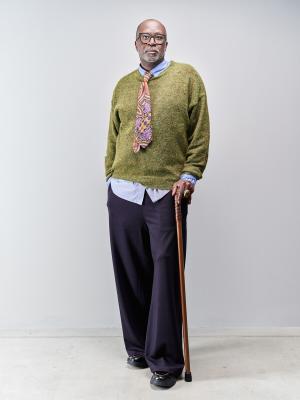
Katy Whitman, the AGO's Conservator of Photographs. Photo by Craig Boyko. Courtesy AGO.
From polaroids to photo albums and works spanning from the 19th to the 21st centuries, Collective Visions reflects the diversity of the AGO’s photography collection, both in content and photographic mediums. Foyer spoke with Whitman to learn more about the conservation efforts involved in preparing these works for the exhibition.
Foyer: Can you tell us a bit about your role as Conservator of Photographs at the AGO?
Whitman: As the photograph conservator, I clean, repair, and generally take care of all the photographs in the Collection. I am responsible for all of the photographic processes in the Collection, from salted paper to daguerreotypes, gelatin silver prints, and digital photographs. This also includes all the different substrates, including paper, plastic, glass, canvas, or fabric. If a photograph in the Collection is damaged, it is my responsibility to treat it and make it stable for storage or exhibition purposes. I also create condition reports, prepare works for loan to other institutions, and assess new works coming into our Collection.
Out of the 70,000 works in the AGO’s photograph collection, there are 94 works on view in Collective Visions. What are some of the key conservation considerations leading up to this photography exhibition?
I assess whether the photograph is stable enough to be exhibited and if it needs treatment to look its best while on view. I also use my training as a conservator to determine the parameters a photograph should be displayed under, such as light levels, the duration a photograph can be displayed, and whether it should be matted or framed.
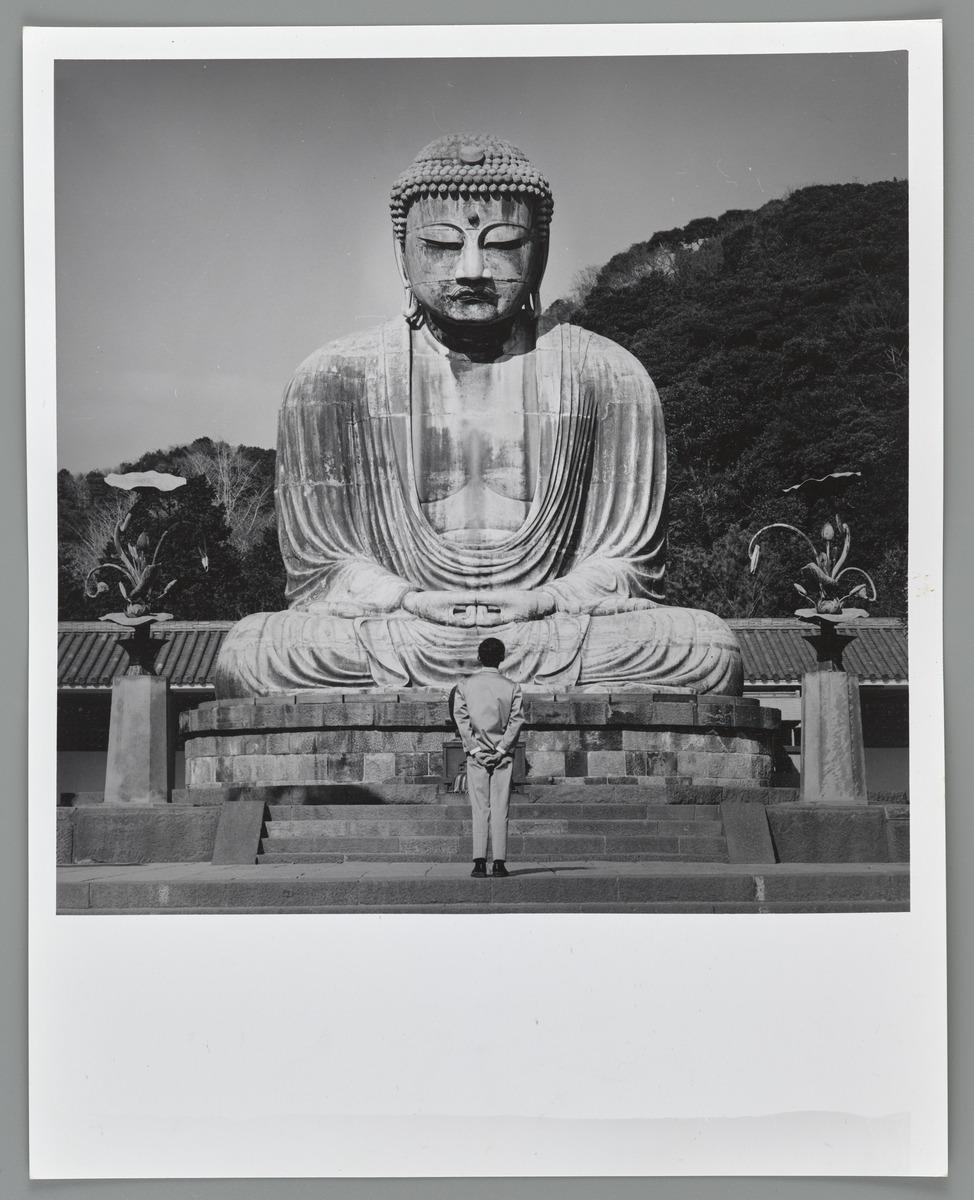
Tseng Kwong Chi. Kamakura, Japan, 1988. Gelatin silver print, Overall: 25.3 × 20.2 cm. Art Gallery of Ontario. Purchase, with funds from the Marie-Louise Stock Fund in memory of Valentine Stock, George Yabu & Glenn Pushelberg, Judy Schulich in honour of Julie Saul, Eleanor & Francis Shen in memory of Laura Rapp, Woodrow A. Wells, Kate Subak, Andrew Grimes and Jamie Stagnitta, 2024. © Muna Tseng Dance Projects, Inc., 2024/202
Collective Visions features a diversity of photo objects, from different types of prints to tintypes and ambrotypes. How does the conservation of photo objects change depending on factors such as substrate, format, and medium?
The conservation of different types of photographs can vary widely depending on the type of photograph. There are so many variables involved in conservation. The medium will determine my choice of cleaning methods, solvents, adhesives, and preservation techniques, as well as recommendations for the duration of display. Each photograph process has its own host of variables that affect stability, light sensitivity, and preservation techniques. For example, a gelatin silver photograph printed after 1950 will have optical brighteners in the paper base, which improves the image's contrast. The downside is that they deteriorate with exposure to light. This means that the prints can be displayed for less time than those from before 1950.
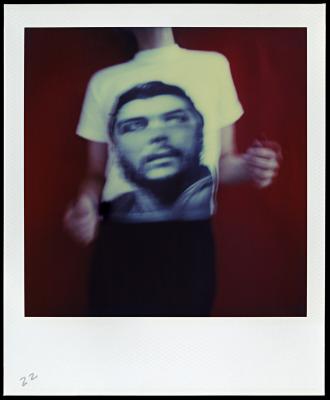
Certain works in this exhibition require special care, including André Kertész’s Picture of Elizabeth, with crown of thorns (1980), which is exhibited covered with a curtain that can be lifted to view the work, and William Wegman’s Floor Piece (1980), which had to be switched with another work halfway through the exhibition. Can you explain why special conservation precautions were taken with these works?
Those works are different types of one-of-a-kind Polaroid photographs, which are very light-sensitive and should be displayed for no more than three months at 50 lux (the light level throughout the exhibition). Polaroids will degrade in dark storage but will degrade at a much faster rate when exposed to light. Kertész’s work, Picture of Elizabeth, with Crown of Thorns, is particularly vulnerable because it has cracking of the image layer and discolouration of the image. Displaying it with a curtain makes it viewable with minimal light exposure.
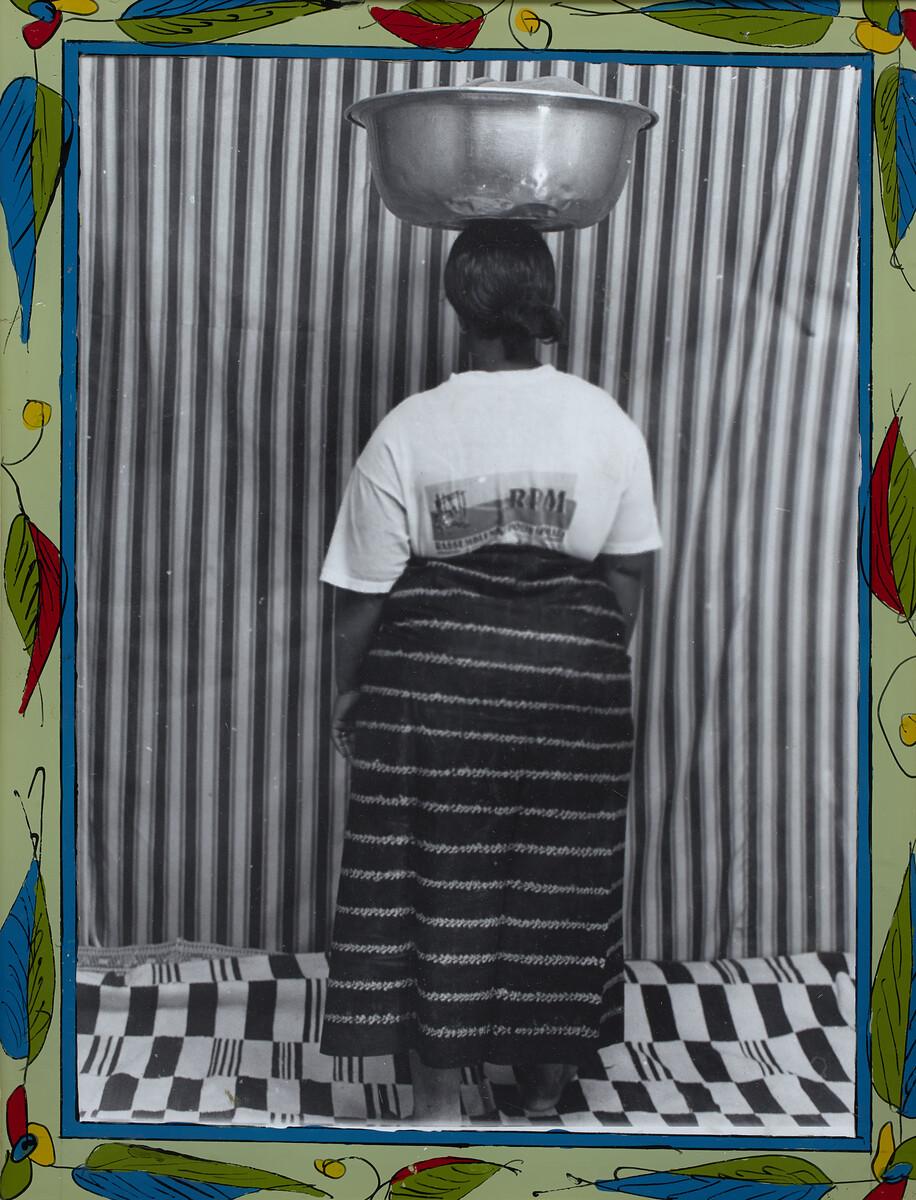
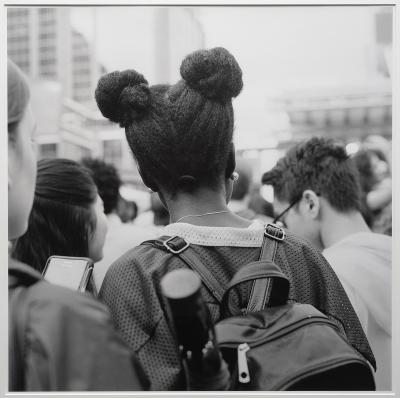
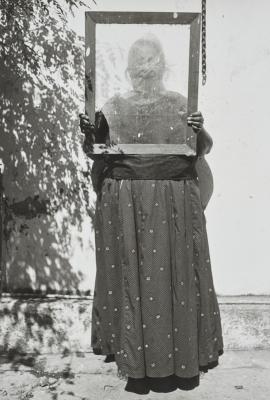
Malick Sidibé. Vues de dos - Juin, 2003. Vintage gelatin silver print, glass, paint, cardboard, tape, and string, Image: 36.2 × 26.4 cm. Art Gallery of Ontario. Purchase, with funds from the Photography Curatorial Committee, 2020. © Malick Sidibé. Courtesy of the family of Malick Sidibé and Jack Shainman Gallery, New York. 2019/2335
Collective Visions celebrates the 25th anniversary of the AGO’s photography department. As someone who has worked closely with the collection for almost two decades, what has it been like to watch the photography collection grow and evolve?
It has been such a rewarding journey to watch the Collection grow into something truly extraordinary. We've been able to bring in such a diverse and meaningful range of works — from intimate community snapshots like the Casa Susanna collection, to iconic artists like Diane Arbus, to historical gems like Linnaeus Tripe's 19th-century photographs from India. Every new acquisition feels like adding another fascinating chapter to an ever-expanding story of what photography can be.
Visit Collective Visions: Celebrating 25 years of Photography, now on view on Level 1 of the AGO in the Edmond G. Odette Family Gallery (gallery 128) and the Robert and Cheryl McEwen Gallery (gallery 129). Collective Visions will be on view until May 10, 2026, and is organized by Sophie Hackett, the AGO’s Curator of Photography.










![Unknown photographer, Chillin on the beach, Santa Monica [Couple on beach blanket]](/sites/default/files/styles/image_small/public/2023-04/RSZ%20WMM.jpg?itok=nUdDiiKr)