Presented by Signature Partner

Oct 21, 2026
The Blue Rocker
From 1912 to 1914, David Milne experimented with bold and dense colour in his paintings
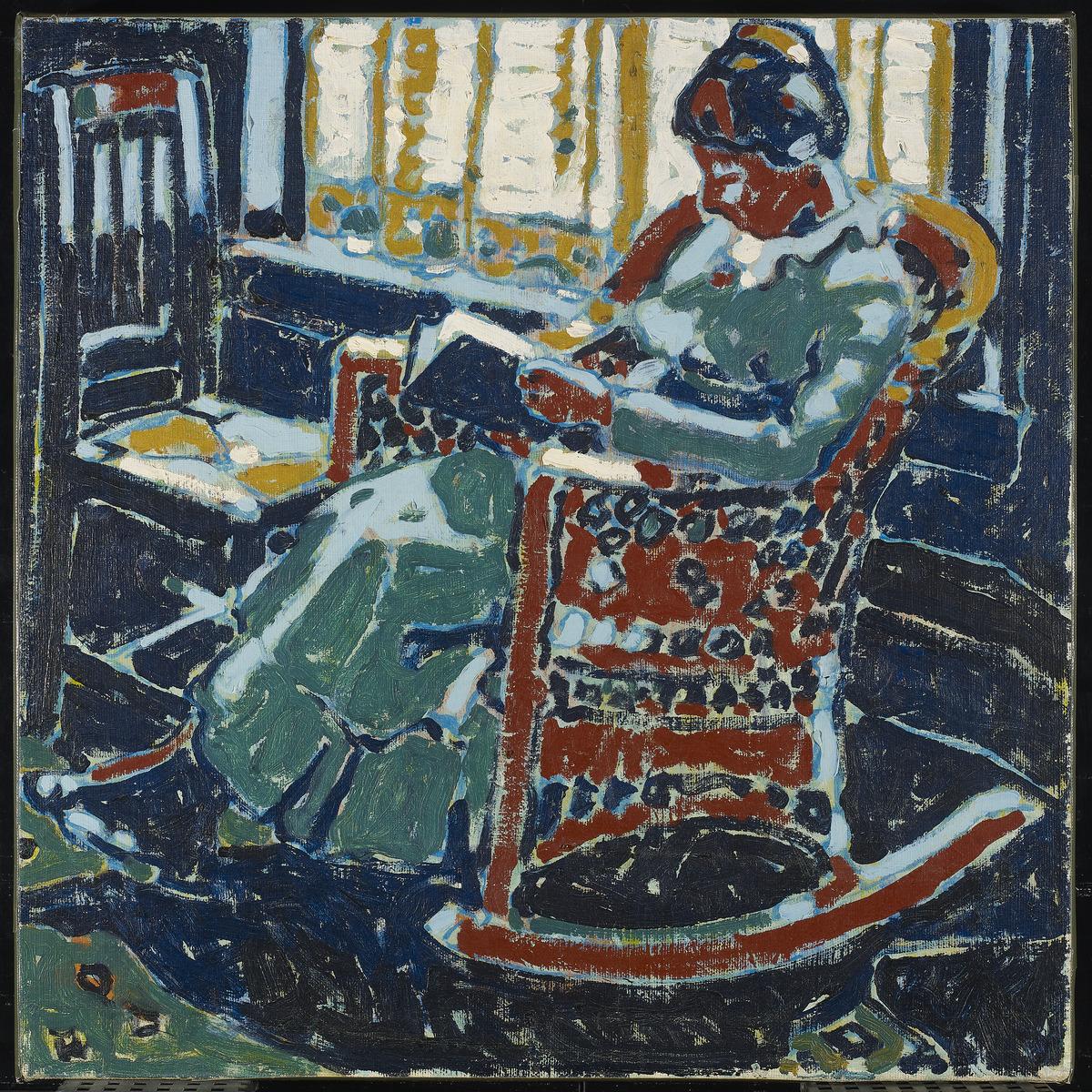
David Brown Milne, The Blue Rocker, 1914. Oil on canvas, Overall: 50.8 x 50.8 cm. Art Gallery of Ontario. Anonymous gift in memory of J.S. McLean, Esquire, 1958. Photo © AGO. 57/24
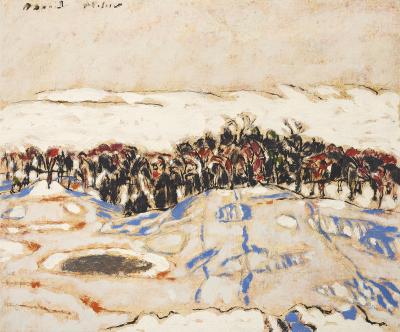
Many may be most familiar with David Milne’s (1882–1953) minimalistic landscapes of rural Ontario. However, these paintings represent only a stylistic snapshot of the approximately three thousand paintings Milne created during his career.
Milne experimented with his style throughout his practice, working to distill a painting down to its essentials and achieve visual unity. Born and raised in Bruce County, Ontario, he moved to New York City in 1903 to study art. He initially wanted to be a commercial artist but eventually decided to become a painter in 1910. Over the next couple of years, Milne began developing the aesthetic elements that would define his work over the next 40 years.
From 1912 to 1914, Milne incorporated bold, dense colours into works like The Blue Rocker (1914). This painting depicts his wife, May Frances Hegarty, better known as Patsy, in deep hues of blue and green, sitting in a rocking chair, lost in a book.
Milne met Patsy in 1906 while working as a poster artist to make ends meet during his studies. The pair married after six years of courtship, and from 1912 onwards, Patsy became a frequent subject in his paintings. This is especially true in the winter of 1913–1914, when Milne often painted interiors of the couple’s Bronx apartment. Multiple paintings from this time feature Patsy, often seated in her rocking chair.
During this period, Milne began focusing on creating oil paintings that convey both force and simplicity. Milne used only up to seven colours in a painting, not including black and white, which he used for highlights and outlines. Though dense with colour, Milne maintains balance in this work by contrasting rough and smooth textures. This work was also made around the time Milne began incorporating elongated oval shapes to create texture and fill space.
Major changes in Milne’s style often coincided with a change of place. In 1916, Milne and Patsy left New York City for Boston Corners, a hamlet in northern New York State. There, his style became characterized by dense, dry brushstrokes, and his main subjects became the surrounding lakes and hills.
Experience The Blue Rocker and the overall transformation of Milne’s style by visiting the David Milne Centre on Levels 1 and 2 of the AGO (galleries 145 and 240).